
Body Mapping
“
Beware that your hearts are not easily deceived, and that you do not turn away and serve other gods, and worship them
-Deuteronomy 11:16
”
Ancient Hebrews Used Body Parts Semantically Different than Modern English Speakers
Hebraic anthropology and idiomatic psychology of the late Second Temple era used body parts as metaphor stand ins in ways that are often contrary to how modern English speakers would understand them and not making that conversion can often lead to theological confusions or missed depth of understanding.
The Hebrew Heart (לֵב / לֵבָב)
In Hebrew anthropology, the lev (heart) was not the seat of emotion primarily, but the center of intellect, moral will, and self-reflection. It was the locus of:
deliberation and decision [1 Kings 3:12],
moral discernment [Psalm 15:2],
self-knowledge and intention [Jeremiah 17:9–10].
Thus, “deceiving one’s heart” (makh’shiv libo, metaʿeh libbo, shoteh et-libbo, etc.) as seen in [James 1:26; Jeremiah 17:9] and elsewhere would not be self-flattery in a sentimental sense, but self-delusion about one’s own moral standing, motives, or spiritual condition. It would be akin to fooling one's own mind.
In essence “deceiving the heart” already implies a self-justifying blindness — the internal corruption that makes one think good is evil and evil good [Isaiah 5:20].
In Hebrew wisdom and sectarian writings (e.g., Ben Sira, Dead Sea Scrolls, 1 Enoch, Testaments of the Twelve Patriarchs), the idiom or its equivalents appear as:
- חנף בלבו (“hypocritical in his heart”) — [Sirach 1:29-30] warns not to “be a hypocrite in your heart.”
- פתויי לב (“enticing of the heart”) — [Sirach 3:26 & to a degree Proverbs 7:25] used for internal temptation.
- מַדַּע שֶׁקֶר בְּלֵב אִישׁ (“false knowledge in a man’s heart”) — a phrase at Qumran (e.g., 1QS III, 9–10) meaning self-deception about righteousness.
- Solomon’s prayer for wisdom uses the Hebrew concept of an “understanding heart” (לֵב שֹׁמֵעַ, lev shomea) in [1 Kings 3:9-11] in a clearly intellectual framework.
The Essenes saw this as betraying one’s inner covenant, a failure to test one’s thoughts against divine truth. “Deceiving one’s heart” meant claiming purity while walking in the spirit of deceit — a concept echoed in [James 1:26], which preserved the Hebrew idiom through Aramaic talking about the moral self-fraud of a person who manipulates conscience — not ignorance, but willful self-justification. Someone who is pretending innocence while knowing guilt, believing one’s motives pure when they are not, or rationalizing disloyalty to covenant truth.
“
If anyone thinks he is religious and yet does not bridle his tongue but deceives his own heart (fools his brain), this person's religion is worthless.
-James 1:26
”
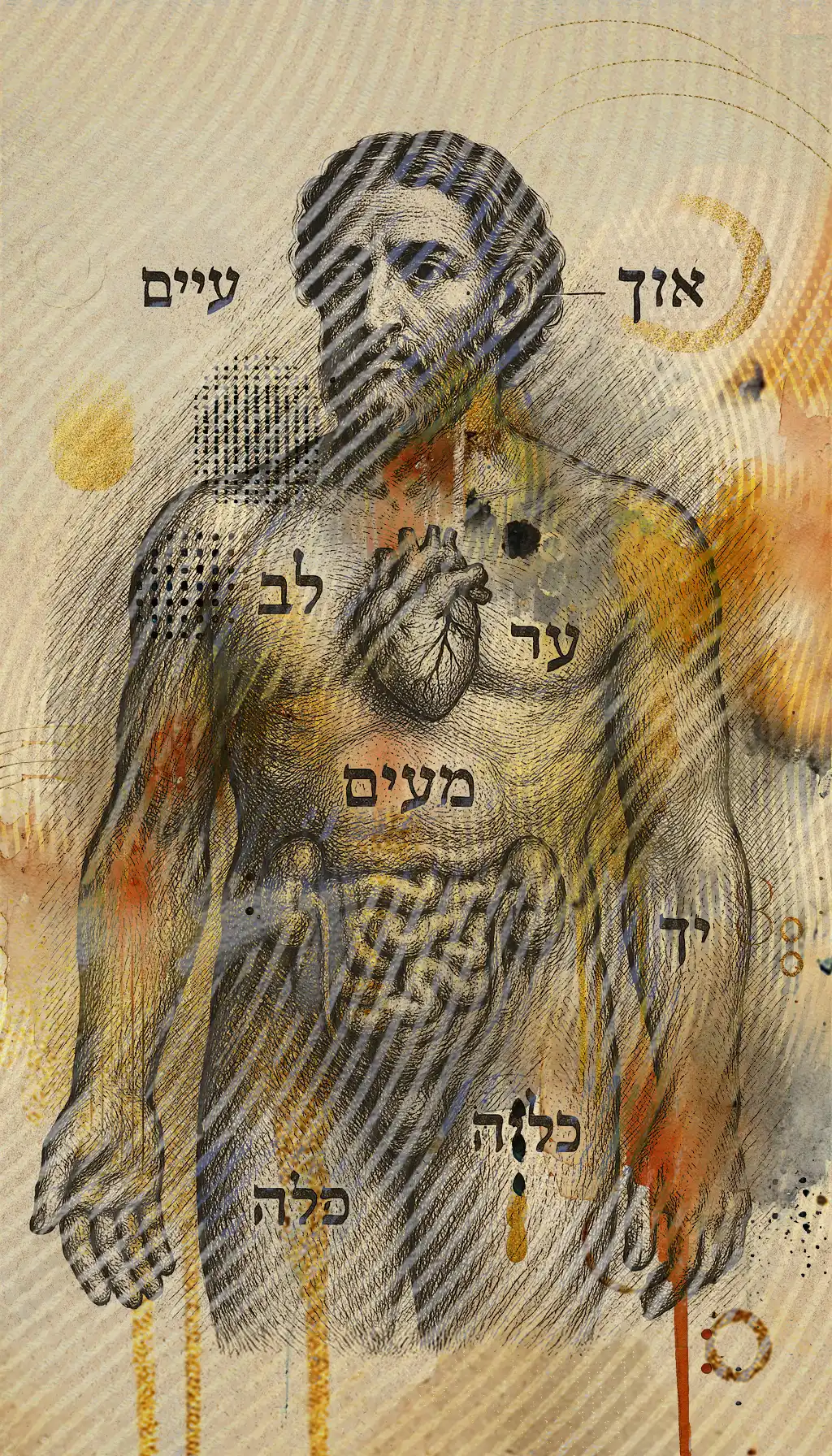
Table of Contents
The Hebrew Life-Force (נֶפֶשׁ)
Here in Hebrew the nefesh (literally throat the organ for breathing and sustenance) was seen as the animating life essence but not the soul which Hebrew didn't have a word for. In modern English it would be viewed as the conscious, breathing heartbeat vitality that pulses through the body — the seat of appetite, emotion, and self-preserving desire. A poor oversimplification is all that you are that is rooted in this physical reality like a Feudian id that ate, breathed, feared, and desired; that needs the wisdom of God. The nefesh exists in all living beings including animals [Genesis 1:20; 2:7, 9:15 and more] and is often translated as just people.
Ancient usage:
The life force or entire living being, a person.
“My nefesh thirsts” [Psalms 42:2] = “My throat longs,” i.e. “I desire deeply.”
“A nefesh that sins” [Leviticus 4:2] = “A person who sins.”
A nefesh is incomplete for life after death unless it has the ruach.
The Hebrew Mood/Spirit/Personality (רוּחַ)
The Ruach is the spirit/personality of the person, or of Yahweh (Ruach hakodesh רוּחַ הַקּוֹדֶשׁ or the holy spirit). Literally it is the wind or breath of the person. Not to be confused with the nefesh which is the part of the body (basar) that is from the dust and lives on the earth or in the grave (both being the word Eretz אֶרֶץ). The ruach is the term you would use when talking about someone at a funeral when you are describing their personality and all the elements that you will miss about them. Not their physical attributes or desired that are dead before you but that which made them intrinsically them. Hebrews thought with their heart, lived in their nefesh and were their ruach, knowing that without the ruach of Yahweh they couldn't do anything great including live after their nefesh was dead.
“
You send forth Your Spirit (ruach), they are created; And You renew the face of the world.
-Psalms 104:30
My spirit (ruach) shall not abide in man forever, for he is flesh.
-Genesis 6:3
I have filled him with the spirit of God (Ruach Elohim) in wisdom and understanding, and in all kinds of craftsmanship.
-Exodus 31:3
”
The Hebrew Kidney (כִּלְיוֹת)
We today regard the kidney as purely biological filters but Hebrews saw the Kilyot (כִּלְיוֹת) as both the literal organs where the best fat for Elohiem were but also as the seat of conscience, affection, and inner emotion. In Hebrew thought, they were the deep inner sensors of truth and desire — roughly analogous to our “gut feeling.”
“
But, LORD of armies, who judges righteously, Who puts the feelings (kidneys) and the heart to the test, Let me see Your vengeance on them, For to You I have committed my cause.
-Jeremiah 11:20
I bless Yahweh who counsels me; even in the nights my kidneys instruct me.
-Psalm 16:7
”
The Hebrew Bowels (מֵעֶה)
The Me'eh (מֵעֶה) is the hebrew term for the intestines which were their source for deep emotion, pity, grief, yearning, fear & internal turmoil. Modern English might say my heart breaks but 1st century Hebrews would have said my bowels churn.
“
Indeed, as often as I have spoken against him, I certainly still remember him; Therefore My bowels growl for him; I will certainly have mercy on him,” declares the LORD.
-Jeremiah 31:20
My bowels, my bowels! I am pained at my very heart... I cannot hold my peace, because you have heard, O my soul, the sound of the trumpet, the alarm of war.
-Jeremiah 4:19
”
The Hebrew Eyes (עֵינַיִם)
The 'Enayim (עֵינַיִם) is the hebrew term for eyes but for them it wasn't just sight but also intentions and one’s inner moral and spiritual orientation, especially toward wealth, generosity, and the needs of others.
- “Eyes” = perception, judgment, desire, and divine awareness.
- “Every man did what was right in his own eyes” [Judges 17:6] = self-determined moral perspective.
- “Eyes of the LORD” = God’s omniscient vision.
The most common and loaded idiom with eyes is the "Good Eyes" & the "Bad Eyes".
The phrase "Good Eyes" refers to a generous, open-hearted, contented, and sincere outlook — someone who trusts God rather than clings to wealth, and who is willing to give and share. In the cultural background of Jesus’ audience, having a good eye meant being generous, free of envy, and focused on what truly matters, not just material gain.
A "Bad Eye" on the other hand refers to the opposite disposition — a stingy, covetous, self-centered, or begrudging perspective. Rather than celebrating others’ blessings or giving freely, a person with a bad eye harbors envy, greed, or a begrudging attitude toward possessions. Many ancient Jewish texts use this same expression to describe someone whose heart is not generous toward others.
In [Matthew 6:22–23], Jesus says your eye is like a lamp for your body. If the eye (your inner focus or attitude) is good or healthy, your whole life is “full of light.” But if it’s bad/evil — filled with greed or envy — then your whole life is “full of darkness.” This metaphor points to the condition of the heart more than literal vision.
The idiom of good/evil eye was common in Jewish and broader Near Eastern culture, and did not primarily mean a literal curse-causing gaze in this context, but a moral disposition.
In Old Testament wisdom literature (like Proverbs), similar language is used to describe generosity versus greed — a person with a good eye gives to the poor, while a person with an evil eye is grasping and stingy.
The Hebrew Ear (אָזֶן)
The ear, Ozen (אָזֶן) is the hebrew term for Understanding / Obedience
Ancient meaning:
- Literally the organ of hearing, but figuratively attentive obedience.
- “To have an opened ear” = to be teachable [Isaiah 50:5).
- “They stopped their ears” = moral refusal to heed.
the ear is merely a sensory organ; in Hebrew thought, it was the gateway of moral response. To “hear” (shama‘) was to heed, to internalize, and to act.
The “stiff neck” symbolized resistance — the refusal to turn or incline the ear. Thus, the ears were the pathway by which teshuva (repentance, turning back) could begin to be achieved.
“
“Today, if you will hear His voice, do not harden your hearts.”
-Psalm 95:7–8
“Incline your ear, and come to Me; hear, that your soul may live.”
-Isaiah 55:3
”
The Hebrew Hand (יַד / יָדַיִם)
The hand, Yad / Yadayim (יַד / יָדַיִם) was more than the literal palm and five fingers in Hebrew. It was nearly universal meaning for agency, power, possession and delegated authority. We use the idea similarly in some ways still today; "in good hands" "hand of the king" the "closed fist vs the open palm". The Hebrew understanding and use of hand was more direct and meaningful. To lay hands on someone wasn't just to put your palm on them it had a more intense subtext. The hand was the ethical posture of the person, be it clenched in greed or violence; or open in mercy and giving. Is it the right hand of favor, covenant and victory or the left hand of restraint, justice and discipline. It was the visible indicator of your actions or the actions of others on you in relation to the will of Yahweh.
Ancient meaning:
- Instrument of control, possession, and authority.
- “Into your hand I commit my spirit” [Psalms 31:5] = “Into your power.”
- “Strong hand” = decisive action.
- "Open hand to the poor" [Deut 15:8] more than just helping or donating but serious generosity and righteousness
The Hebrew Faces (פָּנִים)
The faces, Panīm (פָּנִים) in Hebrew was used as a stand-in for one’s presence, favor, or relational stance toward another — whether benevolent or hostile. To be before the faces of YHWH was to stand in His immediate presence; to have His faces turned toward you meant divine favor, while to have His faces hidden meant alienation or disfavor.
The word face is always plural in Hebrew — panīm — suggesting that a person does not possess a single static “front,” but many facets of presence and expression. To “hide your faces” is to withdraw relational access or favor; to “lift up one’s face” toward another is to grant acknowledgment, mercy, or acceptance.
This plurality of faces hints at the multiple presentations of the self that interact with the world — the different “faces” one shows at home, in public, or before God. A useful modern analogy is the public persona of a celebrity: an individual maintains several overlapping images — the private self, the curated public image, and the performative stage presence. In ancient Hebrew thought, however, these were not deceptions but dimensions of relational being. One’s panīm was the living surface of the soul — the part of you that turns toward or away, that can shine with favor or fall in shame.
Ancient meaning:
- The visible “front” of being, meaning presence, attention, relational stance.
- “Before the face of YHWH” = “in His presence.”
- “Hide your face” = withdraw favor.
The Underlying Pattern
In the Hebrew imagination of the late biblical and Second Temple era, the body was not a shell but a speaking being. Each organ expressed an aspect of thought, desire, or conscience. Cognition was embodied — the heart thought, the kidneys felt, the ears obeyed, the hands acted, and the face revealed. Moral and spiritual life were somatic; the body was the grammar of the soul. The organs were not metaphors for emotions but living instruments of inner reality — channels through which the unseen self took form in flesh and gesture.
In this integrated view, body, breath, and spirit formed a single continuum of life. To live rightly was to live in harmony — the heart discerning, the hands doing, the kidneys sensing, the face turned toward God.
Modern thought, shaped by Greek dualism, divided what the Hebrews united: reason to the brain, emotion to the heart, instinct to the gut. The result is abstraction — a mind severed from its flesh. Hebrew anthropology, by contrast, saw no such fracture: the person was one living whole, whose every heartbeat, breath, and gesture spoke the language of the soul.
Read "New Covenant Terms"
For more information see "New Covenant Terms".
Read "Emunah"
For more information see "Emunah".
Read "4Q246: 4QAramaic Apocalypse"
For more information see "4Q246: 4QAramaic Apocalypse".