
3Q15 Copper Scroll
“
But now at this time it was that one of the priests, the son of Thebuthus, whose name was Jesus, upon his having security given him, by the oath of Caesar, that he should be preserved, upon condition that he should deliver to him certain of the precious things that had been reposited in the temple note came out of it, and delivered him from the wall of the holy house two candlesticks, like to those that lay in the holy house, with tables, and cisterns, and vials, all made of solid gold, and very heavy.
He also delivered to him the veils and the garments, with the precious stones, and a great number of other precious vessels that belonged to their sacred worship.
The treasurer of the temple also, whose name was Phineas, was seized on, and showed Titus the coats and girdles of the priests, with a great quantity of purple and scarlet, which were there reposited for the uses of the veil, as also a great deal of cinnamon and cassia, with a large quantity of other sweet spices, note which used to be mixed together, and offered as incense to God every day.
A great many other treasures were also delivered to him, with sacred ornaments of the temple not a few; which things thus delivered to Titus obtained of him for this man the same pardon that he had allowed to such as deserted of their own accord.
-Flavius Josephus, Jewish War 6.387
”
What is the Copper Scroll
3Q15 (Third Qumran cave, fifteenth scroll) also known as the Copper Scroll is a very unique treasury scroll carved into copper mixed with 1% of tin instead of the typical parchment or papyrus. Originally rolled up it had to be carefully cut into sections to be unrolled and read due to the fragility of it.
The Copper Scroll lists 64 locations where vast quantities of gold, silver, and other precious items are supposedly hidden. The text is essentially a treasure map, providing details on where these treasures can be found, often specifying exact measurements and distances from known landmarks or other reference points. Unlike other scrolls that are religious or doctrinal in nature, the Copper Scroll is purely a catalog of hidden treasures, making it quite enigmatic. There is no accompanying narrative or explanation as to why these treasures were hidden or by whom.
The directions given in the scroll are often cryptic, using ancient place names or measurements that are difficult to translate into modern terms, adding to the mystery of whether the treasures have ever been found or could be found today.
At the end of the Copper Scroll (3Q15), there is indeed a statement that references another scroll. The text suggests that there is a second scroll, which would provide additional explanations or details regarding the locations of the treasures listed in the Copper Scroll. This supposed second scroll is mentioned to be located in a place referred to as the "Cave of the Column(s)."
The exact wording and translation of this statement can vary, but it generally indicates that the key to fully understanding the Copper Scroll lies in another document hidden elsewhere. However, despite extensive searches, no such second scroll has been found as of 2023.
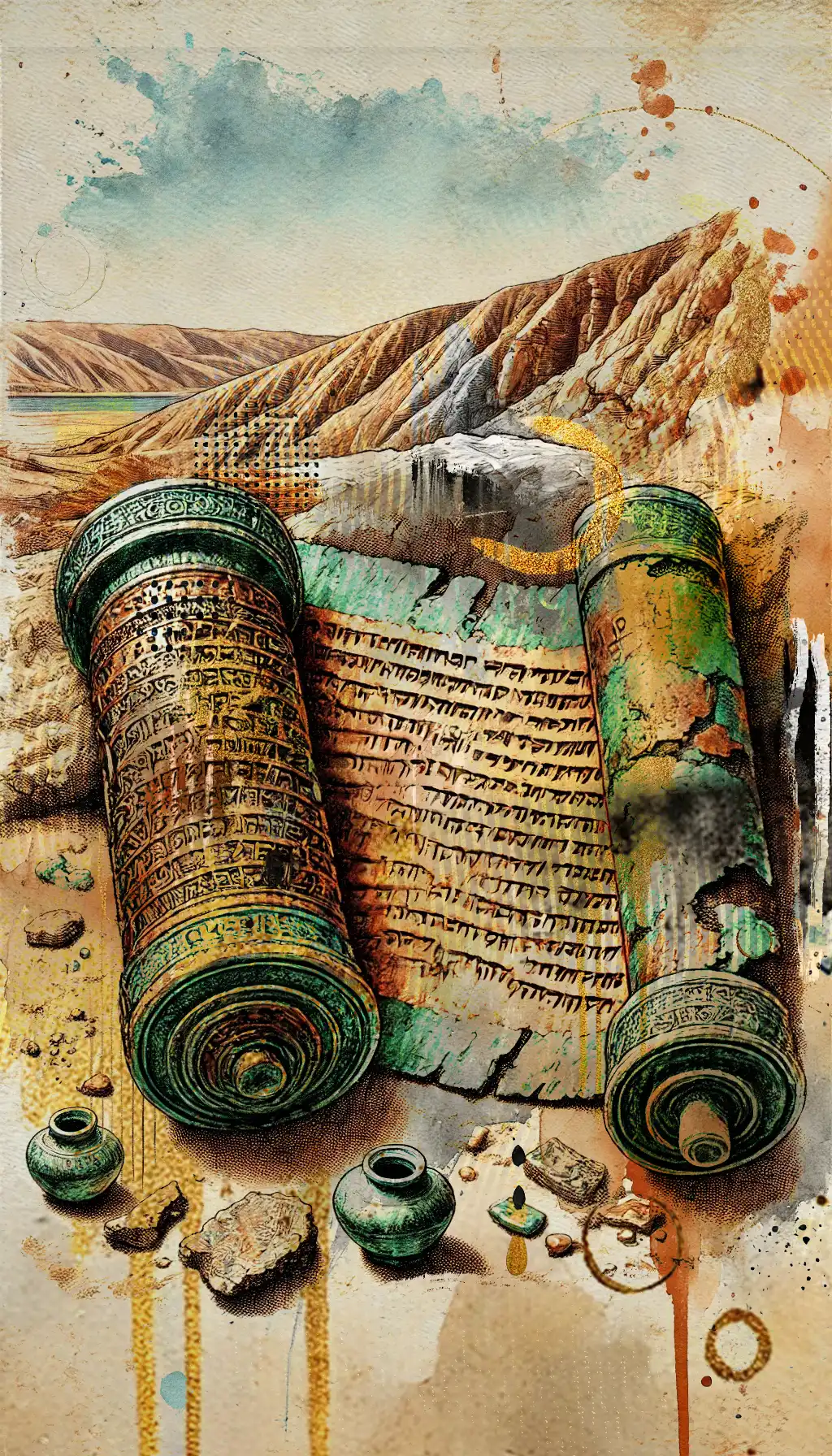
Table of Contents
What Treasure is Listed on the Copper Scroll
The scroll enumerates 64 locations where vast amounts of gold, silver, and other valuable items are purportedly concealed. The total quantity of precious metals is immense, in terms of metals alone it lists over 100 ingots of gold and over 7,386 talents of silver. In addition to metals, the scroll mentions tithing vessels, other ceremonial artifacts, and even references to additional scrolls and priestly vestments. The final entry alludes to a duplicate document providing further details, though this document has not been found.
The entries in the Copper Scroll typically follow a structured format:
- General Location: A broad area or landmark.
- Specific Location: Detailed directions within the general area, often including measurements.
- Contents: Description of the hidden items and their quantities.
For example, the opening lines of the first column read:
“
In the ruin that is in the valley of Acor, under the steps, with the entrance at the East, a distance of forty cubits: a strongbox of silver and its vessels with a weight of seventeen talents.
-Flavius Josephus, Jewish War 6.387
”
Read "11Q13 aka 11QMelchizedek"
For more information see "11Q13 aka 11QMelchizedek".
Read "4Q246: 4QAramaic Apocalypse"
For more information see "4Q246: 4QAramaic Apocalypse".
Read "Gog-Magog War"
For more information see "Gog-Magog War".