
Expanding on a Thought
Grammer | Last Supper | Oral Torah | Passover
Reasons the Last Supper is not a Passover Meal
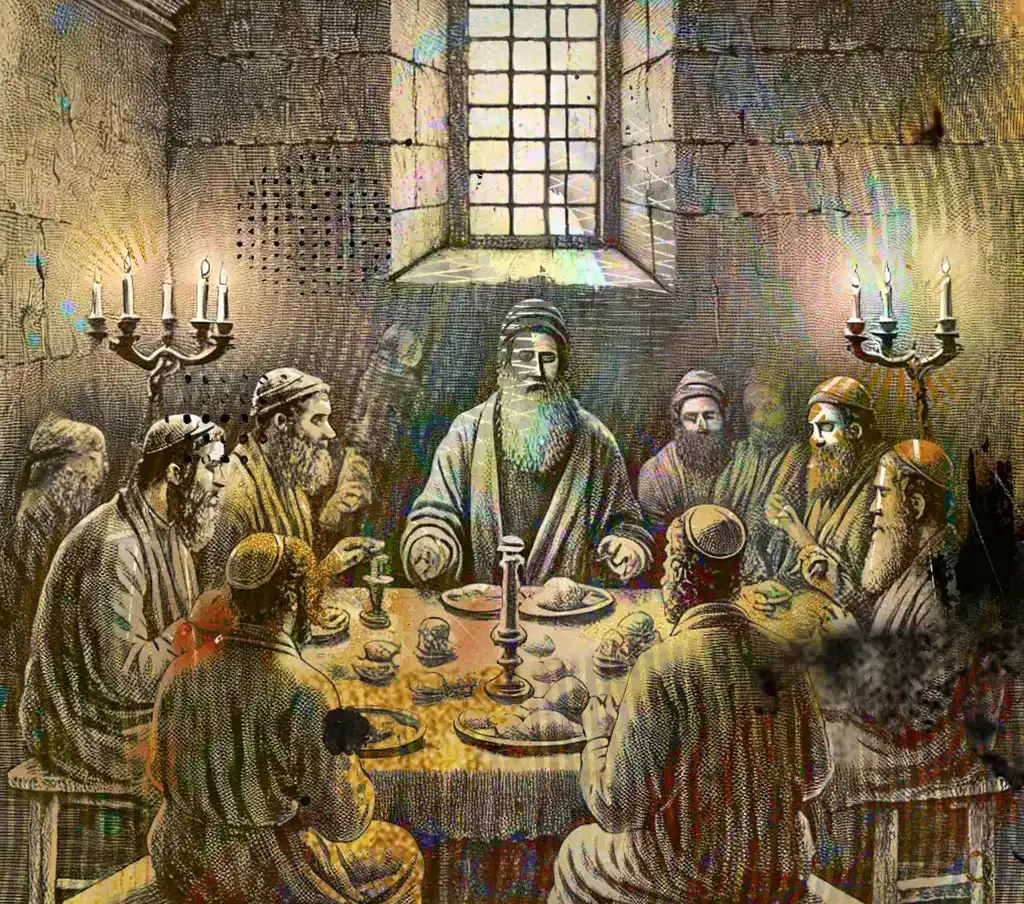
We covered the larger thesis of why the Last Supper was not a Passover/Pesach Feast and was instead a Eirusin Meal in greater detail but to support that here in short are a few more reasons why.
The Greek Term Reason
In the Gospels of Matthew (26:26), Mark (14:22), Luke (22:19), and John (13:18), Yeshua uses the word bread at the Last Supper. In all instances, the recorded Greek word is ἄρτον (arton), which refers to leavened bread. If He had been referring to unleavened bread, the term would have been ἀζύμοις (azymois), as Paul uses in 1 Corinthians 5:8. Additionally, Yeshua dips the bread and gives it to Judas. If the bread had been unleavened, such a dipping would have been impractical. Considering the cultural and religious context, eating leavened bread at a Passover Seder would have been highly inappropriate and insulting.
The Hebrew Term Reason
In addition to the Greek texts, the Shem Tov Hebrew Gospel of Matthew—a 1380 CE work by Rabbi Shem Tov ben Isaac ben Shaprut of Spain written to refute the Gospels—uses the Hebrew word לֶחֶם (lechem), meaning leavened bread, rather than מַצָּה (matzah), which refers to unleavened bread. If the Messiah had indeed been eating leavened bread at Passover, Rabbi Shem Tov would likely have highlighted this as a point of criticism against Yeshua's legitimacy, yet he does not.
The Shopping Reason
As discussed in greater detail in the broader study, the disciples assumed Judas was leaving to buy items necessary for Passover. However, if this meal had been a Passover Seder, such a purchase would have been both late and practically impossible. Passover falls on a high Sabbath when markets are closed, prohibiting any commerce.
The Priestly Reasons
Passover Lamb Protocol:
The preparation of the Passover lamb required priestly oversight at the temple, ensuring that the lamb’s blood did not touch the ground—a ritual with strict regulations.
Temple Officers and Swords:
It was unusual for temple officers to openly carry swords during a high holiday, as doing so contradicts the oral Torah. Though rare, it was not impossible.
Payment to Judas:
Paying Judas the 30 pieces of silver on the night of Passover would have been illegal since the Sabbath forbade buying and selling.
The Preparation Reasons
Luke 23:54–56 clarifies that the day of preparation and the High Sabbath began on Thursday, April 10th, 32 CE. During this time:
Women prepared spices and perfumes to anoint Yeshua’s body, requiring completion before sundown since shops closed for both the High and Low Sabbaths.
Joseph of Arimathea purchased fine linen for Yeshua’s burial, which had to be done well before Sabbath restrictions took effect.
On the evening of Friday, April 11th, the next day’s Sabbath, they rested in accordance with the commandment.
Early Sunday morning, they rushed to the tomb to apply the prepared spices and perfumes.
If the previous night’s meal had been a Passover Seder, all these activities would have constituted significant violations of Jewish law.
The Greek Grammer Reason
Luke 22:15-16 is often mistranslated. In Greek, Yeshua’s statement contains an hebraism idiom translated to greek "epithumia epethumhsa" and a double absolute negative, indicating a better translation:
And He said to them, "At one time in the past I longed to eat this coming Passover with you before I suffer, for I say to you, I will absolutely not eat of it until it is fulfilled in the kingdom of God.
Not
And He said to them, "I have eagerly desired to eat this Passover with you before I suffer; for I say to you, I shall not eat it [again] until it is fulfilled in the kingdom of God.
οὐ μὴ + subjunctive φάγω (aorist subjunctive of ἐσθίω) is a strong, emphatic future negation in Greek: "I absolutely will not eat it".
This statement does not imply that Yeshua was eating the Passover at that moment; rather, He declares that He will abstain from it until its prophetic fulfillment in the Kingdom of God. The verb "eat" is in the aorist subjunctive, but not to express doubt—instead, it forms part of a strong negation (οὐ μὴ φάγω), emphasizing His deliberate refusal to eat until the Passover finds its full meaning. Though He longed to partake, He chooses not to, pointing ahead to His impending sacrifice and the eschatological fulfillment of the meal.


The Hebrew Tradition Reason
Yeshua is recorded in Matthew 26:2 that the Passover is in two days and the Son of man is delivered up to be crucified. This is carried forward by the Messianic Hebrews living in Asia who kept the 14th of Nisan (the day before Passover was prepared) as a holiday to commemorate the work of Yeshua. Called the Quartodecimans (or the Fourteenthers) by Romans, these believers fasted on the 14th of Nisan until the 9th hour (the time Yeshua was on the cross). They would then after the 9th hour rejoice that the work of redemption was done.
Peri Pascha written in 170 AD by Melito of Sardis is a written-out Passover service and prayers that the early Church performed and celebrated on the 14th of Nisan not the day before because they did not view the Last Supper as a Passover meal but the death on the cross as the true Passover.
The Talmud even records Yeshua's death on the 14th day "on the eve of the Passover Yeshu the Nasarean was hanged" Hanged being the term of choice for hung/crucifixtion on a tree or any wooden plank or pole. Not to mention:
Jesus the Nazarene is going out to be stoned because he practiced sorcery, incited people to idol worship, and led the Jewish people astray. Anyone who knows of a reason to acquit him should come forward and teach it on his behalf. And the court did not find a reason to acquit him, and so they stoned him and hung his corpse on Passover eve.
-Sanhedrin.43a.20
There was a Galilean Tradition called, "seudah maphsehket" meaning the last supper. The Seudah Maphsehket, is a tradition observed by Galilean Jews prior to Passover. This meal was held on the evening of Nisan 13, marking the beginning of Nisan 14 (since Jewish days start at sunset). Following this meal, firstborn males would commence a fast, known as the Fast of the Firstborn, in remembrance of the Israelite firstborns spared during the Egyptian plague. This fast continued until the Passover meal on the evening of Nisan 15.
This practice is documented in the Mishnah, specifically in Tractate Pesachim, which details various Passover customs. The Mishnah notes regional differences between Galilean and Judean Jews regarding Passover observances. For instance, Galileans refrained from work entirely on the day before Passover, while Judeans worked until noon. These distinctions highlight the unique traditions maintained by Galilean communities, including the Seudah Maphsehket.
These are just some of the reasons the Last Supper was not a Passover meal.
Why does this all matter, one might ask? It is crucial because details build upon each other, enabling a deeper understanding of the Bible and the messages it conveys. The clearer and more accurate these details are—along with the types and shadows they reveal—the easier it becomes to grasp the underlying points.
The Bible’s message is like a layered GIS map or a hologram. Reading it all at once can be overwhelming, but breaking it down one type at a time brings clarity. When you mentally merge all the layers, you gain a complete rounded picture, much like a city map composed of multiple layers: zoning, roads, electrical lines, sewers, gas and water systems, subterranean passages, support structures, geological strata, and more. Seeing everything at once is incomprehensible, but studying each layer individually makes the information decipherable.
However, if someone introduces incorrect data—such as the claim that the Last Supper was a Passover meal—it only adds confusion and makes understanding even more difficult.
-The Tutor

Read "Ancient Hebrew Wedding Process"
To learn more about the bread and wine meaning.
Read "Cockcrow"
To learn about that night and the crack of dawn denial by Peter.