
Lets Bake A Cake
Education | Meta | Translation | Vocabulary
The Biblical Recipe

We all know when you bake a cake that it is important to understand and plan your ingredients in advance. That, small changes to the ratios, quality, and order don't just make additive differences but can make outsized multiplicative differences in the end product that can make the cake inedible. The Bible is in many ways the same and we have a big problem before we even get to organizing the ingredients.
When you start to cook a recipe, especially a very old one you want to make sure that everything is in a common measurement, be it metric, imperial, or grandma measurements. The Bible is the same except we pretend it isn't.
Step 1: Realize the English is really compromised Greek trying poorly to explain Hebrew Words
As much as many groups would love to pretend that the Bible isn't an ancient Hebrew document, it is, and just translating into English the Koine Greek and Aramaic isn't enough. You have entire ideas and allusions lost in translation. Green isn't Green the world around, some greens have marriage tied to them, others have mold and rot, still others have wealth meanings. Just translating a word as literally as possible cuts off all of the deeper context.
Reading the bible as a single word for word translation without cleaning up the longer word explanations is a recipe for disaster as many references in the Tanakh are lost, word illusions or historical meanings go right over the reader's head. It would be like making the following recipe but you didn't know any of the details in the parentheticals:
Torre de Pan Celestial — A Layered Loaf for the Ages
Ingredients:
- 1 hin of water (≈ 3.6 liters, but only if measured by the priestly standard)
- 2 se’ah of flour (but the margin note says “or 3 omer, depending on your tradition”)
- 1 cup (American) of honey
- ½ “cup” (British Imperial) of olive oil
- 3 Pfennige of salt (a medieval German monetary unit—converted to “a pinch”)
- “Enough yeast to make the dough rise like the morning sun” (a Spanish idiom meaning “a lot,” though some regions use it to mean “barely any”)
- 1 baguette’s length of cinnamon stick (French unit of measurement: de la longueur que tu trouves dans la boulangerie)
- A “handful,” but written in German: eine Handvoll, which in some dialects means an actual handful, in others “a generous amount,” and in others “stop when you feel it is enough”
- “A whisper of saffron” (poetic English, but earlier manuscripts simply say “a strand”)
Instructions:
- “Beat the water as the prophets beat the air.” (A metaphorical Aramaic idiom translated literally into Greek, then into English.)
- Mix the flour until it becomes shalem, (A Hebrew word meaning “complete,” but sometimes used metaphorically for “pure,” “unblemished,” or “at peace.”)
- Add the oil at the “third hour.” (Does this mean 3 AM? 3 hours after sunrise? Or the Roman system meaning mid-morning?)
- Knead the dough “until it remembers who it is.” (A Spanish idiom — hasta que se acuerde de sí misma — meaning “until it regains elasticity.”)
- Let it rest in a “warm place” (topos thermos, which might refer to an oven, or a covered courtyard, or metaphorically to “a place of blessing.” Earlier notes suggest ḥeḏer, a Hebrew term for a protected inner room.)
- Bake it at a seven, which might mean:
bake it on heat level 7
bake it in seven cycles
bake it until it reaches symbolic completeness
or, according to a later gloss, “bake it until golden” - Serve it only after reciting the phrase:
“Comme il était au commencement, so shall it be served,” (a French–English hybrid idiom adapted from a liturgical formula.)
Step 2: Recalibrate the meanings
The Bible as someone once said isn't difficult, and they are right , it is written to everyone, but to understand a 2,000 to 4,000 year old collection of books that has been edited to update it for a 2,500 year old audience (why you see so many places referenced as old name and "now known as" names) you need to recalibrate it and yourself to the original mindset.
That process is started by realizing every term in the bible has a Hebrew meaning and many, many, Old Testament Tanakh references to explain, give context and back up the points. If you have ever seen the graphic of all the lines connecting the books of the bible together you know how there is little in the bible even the words of Yeshua that are not restatements of earlier verses. That isn't a bug or being lazy it is a feature by design.
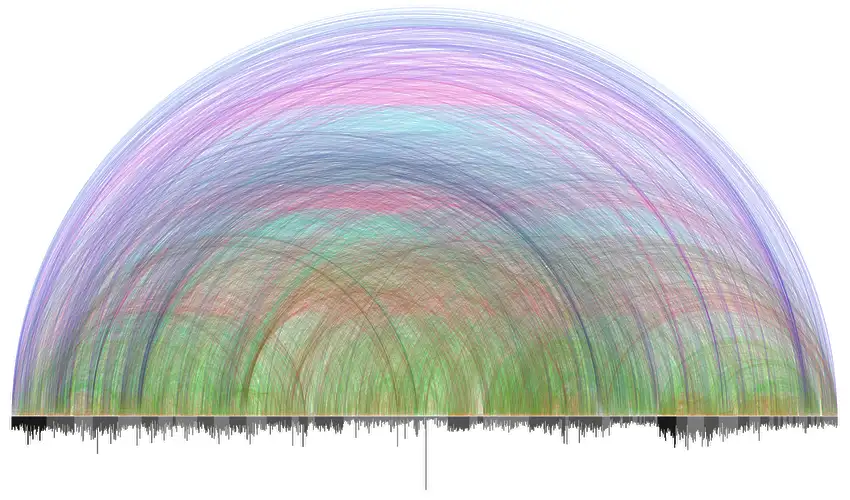
This interconnected bible is pointing you to the original idea, find it, lean on it, and start to learn not just the word meaning but the context it existed in. This will answer so many questions and eliminate so many debates that seem logical when you are struggling with a limited focus English word but become obviously off target with the explained and elaborated Hebrew term. The first and easiest is the struggle between Faith and Works. In English that is an impossible square to circle but in Hebrew it is plain as day. There are many more examples of that to be had.
The meaning of the Bible was meant for everyone but it was couched in a ancient Hebraic context. You have to study, or be taught, or pursue an understanding of that context to even begin to tackle the deeper meanings.
Step 3: Realize the Levels of PaRDeS
Understanding places, people, & vocabulary properly just scratches the surface. Each teaching in the bible has layers of intentionality. The scribes and rabbis taught this in layered depth that eventually became called PaRDeS. Yeshua knew and taught in this way as well which is one of the ways he surprised the establishment teachers and confused so many with his complexity (which was by design).
PaRDeS (פַּרְדֵּס, “orchard”) is a traditional Jewish framework describing four layers of meaning (like four ages: a naked one, a legal one, a one that shows you how to apply, and one where God shows the way) that can coexist in a biblical text. The model assumes that Scripture communicates simultaneously on multiple levels, without those levels competing with or canceling one another. The four levels are ordered from most direct to most conceptually demanding:
- Peshat (פְּשָׁט) — the plain naked sense
Peshat is the grammatical, historical, and literary meaning of the text as it would have been understood by its original audience. It attends to syntax, vocabulary, genre, and immediate context. Peshat does not mean “simplistic” or “literalistic”; rather, it seeks what the text is actually saying within its ancient setting, including idioms and conventions. All other levels are constrained by peshat and cannot contradict it.
“They read from the book, from the Law of God, clearly, and they gave the sense, so that the people understood the reading.”
-Nehemiah 8:8
- Remez (רֶמֶז) — the hinted or allusive sense
Remez identifies meanings suggested indirectly through verbal echoes, thematic parallels, symbolism, or narrative patterns & parables. The text gestures beyond itself, assuming the reader’s familiarity with other Scriptures and shared cultural knowledge. Meaning arises through recognition rather than explanation, and the reader is invited to connect passages rather than extract isolated propositions.
“I spoke to the prophets; I multiplied visions, and through the prophets I gave parables.”
-Hosea 12:10
- Derash (דְּרַשׁ) — the sought or interpretive sense
Derash draws out meaning through interpretation, expansion, and application. This includes rabbinic exposition, parables, ethical teaching, and legal reasoning. Derash may creatively reframe a text to address new situations, but it remains tethered to Scripture and communal norms. It answers the question: What does this text call us to understand or do?
But from there you will seek (root word Derash) the LORD your God, and you will find Him if you search for Him with all your heart and all your soul.
-Deuteronomy 4:29
- Sod (סוֹד) — the hidden or mystery sense
Sod refers to meanings related to divine mystery, cosmic order, or theological depth that are not accessible through linguistic analysis alone. In later Jewish tradition, this includes mystical or esoteric interpretations, but at its core sod reflects the belief that Scripture participates in realities that exceed rational articulation. It is not speculative license, but disciplined restraint before what cannot be fully explained. Sod is given or disclosed by Yahweh, it isn't achievable on ones own. Peter learned this in [Matthew 16:15–17].
“The sod of Yahweh is for those who fear Him, and He makes His covenant known to them.”
-Psalm 25:14
"For the Lord Yahweh does nothing unless he reveals his Sod to his servants the prophets."
-Amos 3:7
PaRDeS is not a ladder where higher levels replace lower ones. It is a layered ecology of meaning in which peshat anchors interpretation, remez connects texts, derash applies them, and sod acknowledges their depth only resolved by Yahweh. Mature reading occurs when these levels are held in tension rather than collapsed into one.
Summary
To really have a grasp of what the Bible is trying to say it takes effort and like a romantic relationship; pursuit. It is work that will be rewarded by Yahweh. For as made clear in the Parable of the Talents [Matthew 25:14-30] or Minas [Luke 19:11-27] the talents are entrusted as knowledge, faithful persuit leads to increase, and fear and passivity results in knowledge being taken away not just neutral growth.
“For whoever has, to him more will be given, and he will have abundance; but whoever does not have, even what he has will be taken away.”
-Matthew 13:12
Pursue your creator and he will enrichen your life with knowledge beyond even what I could begin to write about.
-The Tutor

Read "New Covenant Terms"
To learn more about words we just absorb without context.
Read "Didache"
To learn about how the early Church saw things.
Read "Born Again"
To learn about being saved is more than just a prayer.