
Gog-Magog War
“
All nations surround me; three times Gog and Magog are destined to come up to Jerusalem,
-Midrash Tehillim 118.12
”
What is the Gog-Magog War
The phrase Gog and Magog does not have one universally agreed-upon meaning. It consists of two proper names: Gog and Magog.
The Name Gog
- Hebrew (גּוֹג): Gog does not carry a clear native meaning in Hebrew. It sounds foreign, almost designed to evoke the image of an enemy leader.
- Sumerian theory: Some scholars connect it to gug, meaning “darkness” or “roof/head.”
- Akkadian theory: Others tie it to gagu, meaning “roof” or “mountain peak,” which aligns with the imagery of a northern invader.
The Name Magog
- Biblical genealogy: Magog is listed as a descendant of Japheth and ancestor of northern tribes.
- Linguistic reading: Many scholars interpret it as me-Gog “from Gog” making Magog the land and Gog its ruler.
- Historical identification: Josephus (Antiquities 1.6.1) equated Magog with the Scythians, associating it with northern nomadic peoples. There is debate if Josephus did this to generalize a broader understanding for his readers.
- Later traditions: Magog came to symbolize chaotic tribes beyond civilization, wild nations living on the margins, chaos embodied.
Together, Gog of Magog is often understood as “the king of the land of Magog”, a northern leader ruling over a northern territory.
Modern Theory
Some modern interpretations identify Magog with Russia, but historical sources more closely connect it possibly with the Caucasus region, modern Georgia, Armenia, and Azerbaijan or even east of that. Because this area has at times been under Russian control, some link remains to that theory, but the identification is ambiguous. We feel that to lean more on the disorganized nations and lands that surround Israel would be a safer presumption that specifically stamping Russia with the title.

Table of Contents
The War as Motif
The Gog–Magog War is not a single battle but a recurring motif of human rebellion against God, appearing in multiple traditions:
- Hebrew Bible: Most clearly in [Ezekiel 38–39], where Gog of Magog is described as a northern prince leading a coalition of Meshech (Caucasus and Anatolia), Tubal (Cappadocia and eastern Turkiye), Persia (Iran), Cush (Sudan and Ethiopia), Put (Libya), Gomer (Linked to Cimmerians so central Turkiye or Caucasus region), and Beth-Togarmah (Armenia and parts of Turkiye), to attack Israel in the last days. The locations repeatably pointing to the Caucasus and Eastern Turkiye region. Their invasion is crushed by divine judgment: earthquake, pestilence, fire, and hail.
- Other biblical references: Genesis 10 and 1 Chronicles 1 list Magog among Japheth’s descendants. Numbers 24 (Balaam’s oracle) and Joel 3 (the Valley of Jehoshaphat) echo the theme of end-time wars.
- Second Temple literature: Works like Jubilees and 1 Enoch cast Gog and Magog as cosmic enemies unleashed at the world’s end, linked to “the nations from the four corners of the earth.”
- Later traditions: The New Testament and even the Muslim Qur’an also include Gog and Magog as symbols of the final confrontation between God’s people and overwhelming foreign forces.
In this sense, Gog–Magog represents not just one event but a pattern: at the climax of each age, nations gather in rebellion against God.
In a modern pop culture sense, you might picture it easier as a repetitive “final showdown” moment for humanity and its Creator along the lines of The Matrix Revolutions when Neo meets the Architect, but with violence instead of words.
In Summary
The Gog–Magog War symbolizes the gathering of hostile nations to attack Jerusalem. A rebellion of both human armies and spiritual “princes” (Elohim) seeking to overthrow the word and plan of El/Yahweh.
The First Gog-Magog War
As mentioned above, the Hebrew understanding is that there would be three Gog-Magog wars. The first of which already happened. Many Jewish commentators identify the first war with the Muslim conquest of Jerusalem in 638 AD. However, we see its true fulfillment in the Roman invasion of 70 AD, which destroyed the Second Temple and brought the Age of Torah to a close.
The End of an Age
Each Gog–Magog war occurs at the end of an age. At its core, it is a rebellion patterned after the Tower of Babel—a collective attempt to usurp the authority, word, and dominion of Yahweh. Every age ends with such a rebellion. These rebellions are foreseen by Yahweh: the first is permitted to succeed, while the second and third ultimately fail.
The Roman Campaign
The first war was carried out under Titus Caesar Vespasianus, then Legatus Augusti pro praetore (general), who commanded a coalition of legions and auxiliaries from across the empire. The campaign reflects the confederation imagery in Ezekiel 38–39:
- Legio V Macedonica (from Moesia, Balkans)
- Legio XII Fulminata (from Cappadocia/Asia Minor)
- Legio XV Apollinaris (from Pannonia, Balkans)
- Legio X Fretensis (from Syria)
Plus auxiliaries from:
- Syria (Arabs, Nabateans)
- Asia Minor
- North Africa (Libyan and Egyptian contingents)
Josephus (War of the Jews 3.4.2; 3.5.3) records that the Romans relied heavily on provincial troops, mercenaries, and client-king forces (Herodians, Arabs, Syrians).
The Destruction of Jerusalem
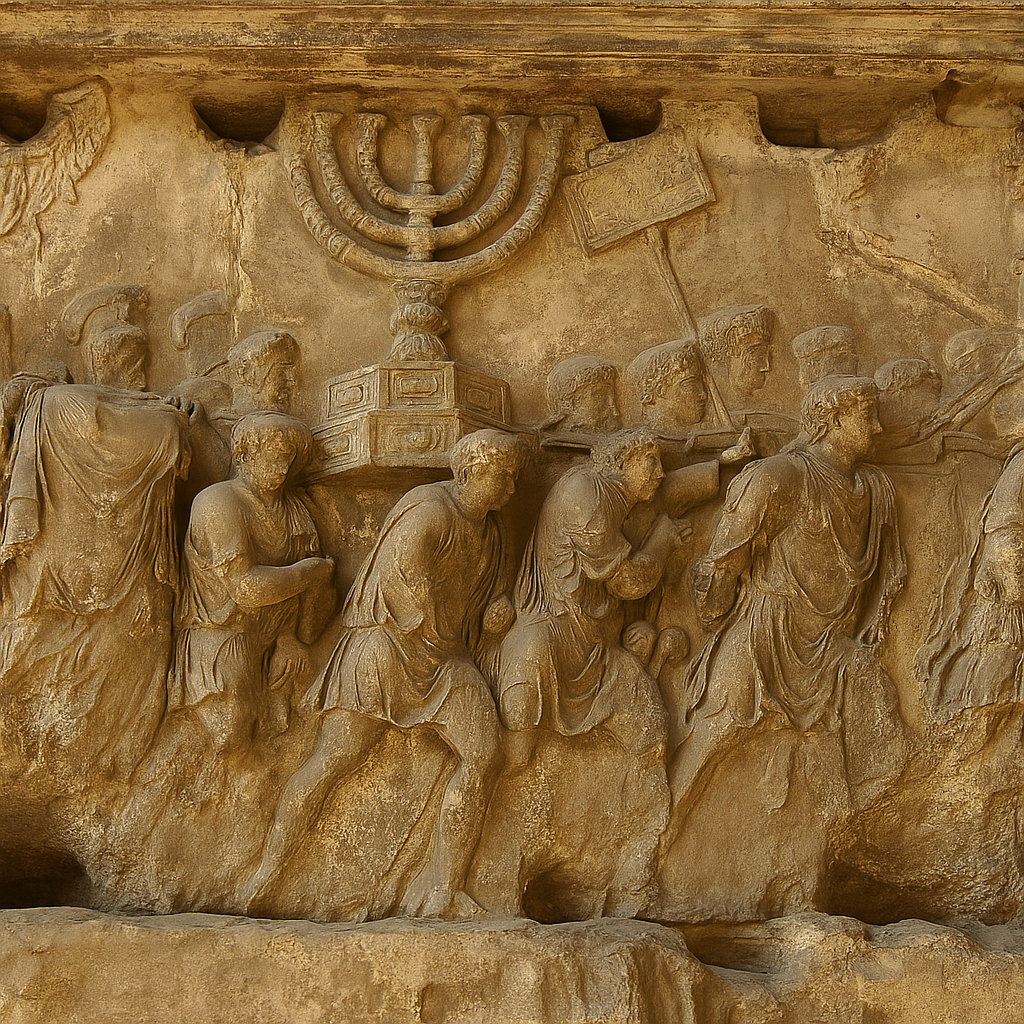
This war culminated in the destruction of Jerusalem and the leveling of the Temple on the 9th of Av—the very date the First Temple had been destroyed by Babylon centuries earlier. The Temple treasures were carried to Rome, famously depicted on the Arch of Titus, which shows Roman soldiers parading the spoils of Jerusalem.
The human toll was staggering: Josephus, himself adopted into the imperial Flavian household and possibly inflating figures for political reasons, records nearly one million Jews killed and about 97,000 enslaved.
Many of the captives were forced into labor on Roman building projects such as the Colosseum (begun in 72 AD). Titus also ordered Jerusalem’s walls and much of the city leveled, leaving only towers and sections of the western wall as a Roman garrison. The Tenth Legion Fretensis was stationed there permanently to suppress further Jewish presence.
Prophecy and Fulfillment
Daniel had written:
“The people of the prince that shall come shall destroy the city and the sanctuary."
-Daniel 9:26
Remarkably, Titus was not technically a prince of Rome until 69 AD, just one year before the invasion. After Emperor Nero’s suicide in 68 AD, civil war followed. The resolution was the elevation of Titus’ father, Vespasian, to emperor. At that moment Titus received the title Caesar and princeps iuventutis (“Prince of Youth”). This late providential development fulfilled Daniel’s prophecy in an unexpectedly precise way: the destruction was led by “the people of the prince who was to come”.
Aftermath and Humiliation
Following his victory, Titus returned to Rome and celebrated a joint triumph with Vespasian. He received the title Imperator Titus Caesar Vespasianus and became co-ruler with his father. Upon Vespasian’s death in 79 AD, Titus succeeded him as emperor.
Vespasian, with Titus’ approval, imposed the fiscus Judaicus, a tax on all Jews across the empire. Formerly, Jews had paid a half-shekel tax to support the Temple in Jerusalem. Now, the same tax was diverted to the Temple of Jupiter Capitolinus in Rome. This humiliation was both punitive and symbolic: Yahweh’s Temple was destroyed, and his worship replaced by that of the "superior" Jupiter.
The tax applied to every Jew in the empire—man, woman, child, even slaves—and also to converts. Under Domitian (81–96 AD), enforcement grew harsh: collectors investigated ancestry and even forced elderly men to undergo physical examinations to confirm circumcision. This fueled tensions between Jewish converts and Gentile Christians.
Later, under Nerva (96–98 AD), some abuses were curtailed. His coins even proclaimed fisci Judaici calumnia sublata (“abuses of the Jewish tax removed”). Still, the tax itself continued in various forms well into the 2nd century, a lasting reminder of Rome’s claim to have subdued the God of Israel.
The Second Gog-Magog War
The second Gog–Magog War is expected to occur at the close of the Age of Messiah, sometime roughly between 2026 and 2077. This conflict would precede the appearance of the Messiah and the beginning of his Millennial Reign. [Ezekiel 38–39 describes a coalition of nations gathering to attack Jerusalem. The alliance includes forces from the north (Meshech, Tubal, Togarmah) and allies from the east and south (Persia, Cush, Put). The scope is presented as overwhelming: the surrounding nations unite against Israel in advance of the Messiah’s arrival.
Because of this expectation, it is possible that the Anti-Messiah (Antichrist) will appear to fulfill these prophecies, presenting himself as the one who secures “final peace” after the war.
The Sequence of Events
- Formation of the Alliance
Gog, the “chief prince of Meshech and Tubal,” stirs up a coalition of nations, including Persia, Cush, Put, Gomer, Togarmah, and “many peoples with you” [Ezekiel 38:2–6]. - The Invasion of Israel
Gog’s forces advance “like a storm cloud covering the land” [Ezekiel 38:9], targeting Jerusalem and the mountains of Israel [Ezekiel 38:8; Zechariah 12–14]. - Internal Chaos Among the Invaders
God declares: “Every man’s sword will be against his brother” [Ezekiel 38:21]. The invading armies turn on each other in confusion, collapsing into violence and civil breakdown. - Divine Intervention
Catastrophic signs follow:
- A massive earthquake [Ezekiel 38:19–20]
- Pestilence and bloodshed [38:22]
- Torrents of rain, hailstones, fire, and brimstone [38:22]
Mountains and walls fall [38:20], which may symbolize both physical destruction and the collapse of nations.
Multitudes perish on the mountains of Israel [Ezekiel 39:4]. Their bodies are left as food for birds and wild beasts [39:4, 17–20]. In early Jewish expectation, Messiah ben Joseph was thought by some to die in this battle—a tradition that could be manipulated in end-time events by the Anti-Messiah or others.
For seven years, Israel uses the invaders’ weapons for fuel [Ezekiel 39:9–10]. This may coincide with the tribulation period and symbolizes a reversal: what was meant for Israel’s destruction instead sustains them.
East to Northeast of the Dead Sea, a valley is designated for mass burial: the Valley of Hamon-Gog (“Multitude of Gog”) [Ezekiel 39:11–12]. Israel spends seven months burying the corpses to cleanse the land.
The Role of the Anti-Messiah
Debate continues about how and when the Anti-Messiah intersects with this conflict. The texts are not entirely clear. Our perspective is that the Anti-Messiah will use the expectations surrounding Messiah ben Joseph and Messiah ben David at the Gog–Magog War to present himself as Israel’s savior. Soon after, he will elevate himself further, replacing Yahweh in the Temple and ushering in the bowls of wrath and the Days of Awe.
Still, prophecy often unfolds with unexpected turns, and the final Jubilee timeframe may hold surprises that defy human anticipation.
The Question of Spoil
Not all nations join Gog’s coalition. Ezekiel 38:13 records that Sheba & Dedan (together make up Arabia), Tarshish (see United Kingdom), and the young lions of Tarshish (USA, AU, NZ, CA) respond with suspicion:
“
Sheba and Dedan and the traders of Tarshish with all its young cubs will say to you, "Have you come to capture spoil? Have you assembled your armies to seize plunder, to carry away silver and gold, to take away cattle and goods, to haul away a great spoil?"
-Ezekiel 38:13
”
This suggests some nations will stand aside, questioning the true motive of the invasion. One theory is that these nations will be suffering from severe economic distress at the time, while Israel may experience dramatic economic growth. Some including us speculate this could involve the discovery of treasures such as the Copper Scroll gold & silver or simply Israel’s continued expansion as a regional economic power.
The Third Gog-Magog War
The third and final Gog–Magog War takes place at the end of the Kingdom Age, one thousand years after the second Gog-Magog War.
- Jewish view: Midrash Yalkut Shimoni on Zechariah 581.
- Christian view: [Revelation 20:1–8].
In this vision, a world that has known vast lengths of lifespan existences, continual peace, and abundant blessing for those who worship the King yearly is deceived one last time. The nations rise in rebellion, surrounding “the camp of the saints and the beloved city” Jerusalem, in numbers “like the sand of the sea” [Revelation 20:8].
This final war is unlike the others. There is no long campaign, no drawn-out chaos, no burial of the dead. Instead, judgment comes instantly:
“And fire came down from God out of heaven, and devoured them.”
-Revelation 20:9
The armies are consumed in a single act of divine destruction. Immediately afterward, the Satan is cast into the lake of fire and brimstone, where the Beast and the False Prophet already are, to be tormented forever [Revelation 20:10].
This marks the end of all rebellion in heaven and earth. History closes with the Great White Throne Judgment, followed by the dawn of the Eighth Day, Shemini Atzeret—the never-ending pause. From there comes the new heaven and new earth, the eternal World to Come (Olam Haba).
Read "Messiah ben Joseph"
For more information see "Messiah ben Joseph".
Read "3Q15 Copper Scroll"
For more information see "3Q15 Copper Scroll".