
Chain of Learning
“
When He entered the temple area, the chief priests and the elders of the people came to Him while He was teaching, and said, “By what authority (שׁמע Shema or Chain of Learning/Transmission) are You doing these things, and who gave You this authority (Shema)?
-Matthew 21:23
”
What is 2nd Temple Chain of Learning?
In Jewish thought, the Second Temple Chain of Learning refers to the continuous transmission of authoritative teaching—from the prophets to the sages—across the Second Temple period (c. 516 BC – 70 AD). It explains how Scripture, interpretation, halakhah, and communal memory were preserved and handed down in an unbroken sequence of teachers.
Pirkei Avot 1:1 presents the classic outline:
a lineage of stewardship stretching from Moses → Joshua → Elders → Prophets → Men of the Great Assembly (Anshei Knesset HaGedolah).
Later rabbinic tradition expands this into a full intellectual genealogy reaching through the Zugot, Hillel and Shammai, and finally the Tannaim. The point is not just history—it is authority. Interpretation rests on a received chain.
Why this chain mattered in the Second Temple world?
The Second Temple era was marked by foreign empires, sectarian fragmentation, and dramatic shifts in religious life. After about 426 BC, Israel understood itself to be without active prophets or kings—a period sometimes called the Era of Silence, or the beginning of a long intertestamental stretch. (this occurred on the 10th and Final Jubilee of Onah 7 marking the start of Onah 8; 2500 years before the end of the Age of Messiah/Grace & 500 years before the end of the Age of Torah).
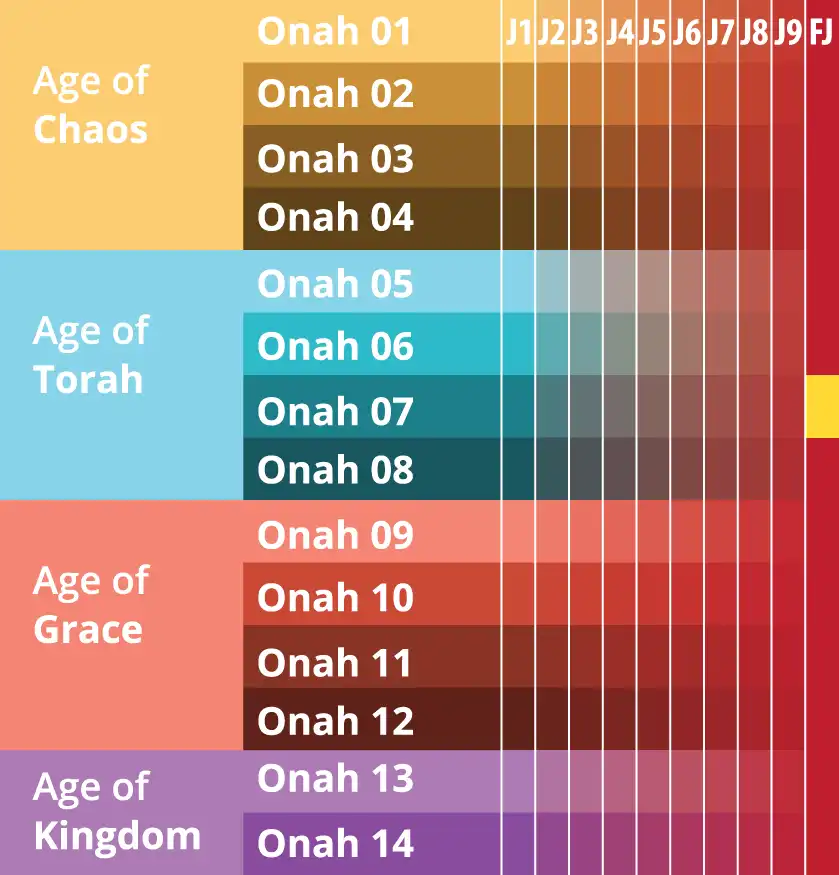
Table of Contents
In that environment, the chain of learning served as a stabilizing claim:
- Revelation had not been lost.
- Interpretation was not chaotic.
- Authority passed through identifiable stewards.
Without prophets, continuity required disciplined memory, scribal guilds, memorized teachings, and developing traditions that safeguarded Israel’s identity.
The chain answered a fundamental question: Who has the authority to interpret Torah when prophets are gone? Rather than a single institution, the answer became a lineage of recognized teachers.
According to Jewish memory, the Great Assembly (c. 5th century BC) reorganized national religious life after the exile. They standardized emerging liturgical forms (including early versions of the Amidah), protected biblical texts, and articulated principles such as:
“Be deliberate in judgment, raise up many disciples, and make a fence around the Torah.”
This group is often viewed as the first institutional node of the post-prophetic chain.
Modern historians debate the exact structure of this body, but agree that early Persian-period scribes played a decisive role in canon shaping and communal leadership—work the chain of learning symbolically encodes.
What is Halakhah
Halakhah (or Halacha) is the collective body of Jewish law derived from the Torah, Talmud, and rabbinic tradition, literally meaning "the way to walk,"
Where Did Yeshua Get His Shema?
The Gospels record sharp confrontations between Yeshua and the Pharisees, debates full of Second Temple assumptions modern readers often miss. One example appears in [Matthew 21:23], where authorities question the source of Yeshua’s “Shema.”
Today we immediately think of [Deuteronomy 6:4], but the Pharisees were not asking why Yeshua recited “Hear O Israel.” They were asking something far more pointed:
Who taught you?
Under whose authority do you interpret Torah?
In their world, the Chain of Learning was non-negotiable. Authorized teaching required a recognized master and a demonstrable lineage. A teacher outside the chain was, by definition, illegitimate.
This meaning is clearest in the Gospel of John, where the religious leaders marvel:
"Then the Judean leaders were amazed, saying, 'How does this man know letters, having never been taught?'"
-John 7:15
In the idiom of the time, “knowing letters” meant mastery of textual interpretation—Scripture plus the oral halakhic traditions. That mastery required training under a rabbinic authority. No one could simply stand up in the Temple courts and begin issuing rulings.
Thus the real question behind “Where is your shema?” was:
“Where is your mishma—your received instruction?”
“What chain of tradition do you stand in?”
To the Pharisees, Yeshua was claiming the right to instruct Israel without demonstrating that He had a legitimate rabbinic pedigree. This was not a minor procedural complaint. It was a direct threat to the gated authority structure that had defined religious leadership since the Hasmonean reforms of the second century BC.
Yeashua’s Answer: A New Kind of Authorization
Yeshua's response is as bold as it is shocking:
“Yeshua answered, 'My teaching is not from Myself, but from the One who sent Me.'”
-John 7:16
In other words:
He does claim a received teaching—but not from any Pharisaic house or rabbinic academy. His chain is not:
Moses → Joshua → Elders → Prophets → Great Assembly → Hillel/Shammai…
Yeshua claimed a different chain:
The Father → the Son
This is why He frequently introduces teachings with the prepositive doubled formula in John or the single in the synoptic:
“Amen, amen, I say to you…”
In Hebrew practice, amen confirms someone else’s statement, a declaration of truth and veracity about a proceeding statement. Yeshua uniquely uses it to as a prefix to introduce His own statements. He cites no teacher because He acts as God’s agent, speaking with direct authority.
In Second Temple usage, amen served to:
- Affirm revelation
- Seal covenant oaths
- Confirm truth spoken about God
Yeshua employs it as a prepositive marker of originary authority—not derivative authority.
Why This Infuriated the Pharisees
From the Pharisees’ point of view:
- A teacher without a transmission lineage was illegitimate.
- A teacher who rejected the lineage system outright was dangerous.
- A teacher who claimed a direct divine chain was blasphemous unless proven by unmistakable signs.
Thus “Where is your shema?” was simultaneously:
- A theological challenge
- A political test
- A social boundary check
- An accusation of unauthorized teaching
Yeshua refuses their framework. His authority does not derive from human institutions but from God, confirmed by His works and prophetic signs.
Recovering the Second-Temple Context Transforms the Reading
Modern readers hear the question as:
“Why isn’t Yeshua formally educated?”
Second Temple audiences heard:
“Who authorized you to interpret God’s Torah? Where is your chain of learning?”
This explains the crowd’s reaction in Matthew 7:29:
“for He was teaching them as one who had authority, and not as their Torah scholars.”
-Matthew 7:29
Because they knew what it meant for someone to teach without citing a school or tradition. It was unheard of.
Yeshua, in effect, steps into Israel as a new Moses—one whose shema comes from the Father Himself, not from the academies of Jerusalem.
In Summary
The Pharisees’ question is not about liturgy. It is about authority—who holds it, who grants it, and who is allowed to interpret the will of God for Israel.
To ask Yeshua for His shema was to demand His place within their chain. Yeshua answers that His place is above the chain, not within it.
The confrontation is therefore a clash between:
Man-authorized teaching
and
God-authorized teaching
Understanding this restores the episode’s original force: it is not a dispute about prayer but a revelation of Yeshua’s identity and a challenge to the religious power structures of His age.

Read "Sadducees"
For more information see "Sadducees".
Read "Pharisees"
For more information see "Pharisees".
Read "Chazal"
For more information see "Chazal".