
Correcting a Misconception
Dates | Halakha | Passover | Resurrection
Three Days and Three Nights: The Chronology of Yeshua’s Death
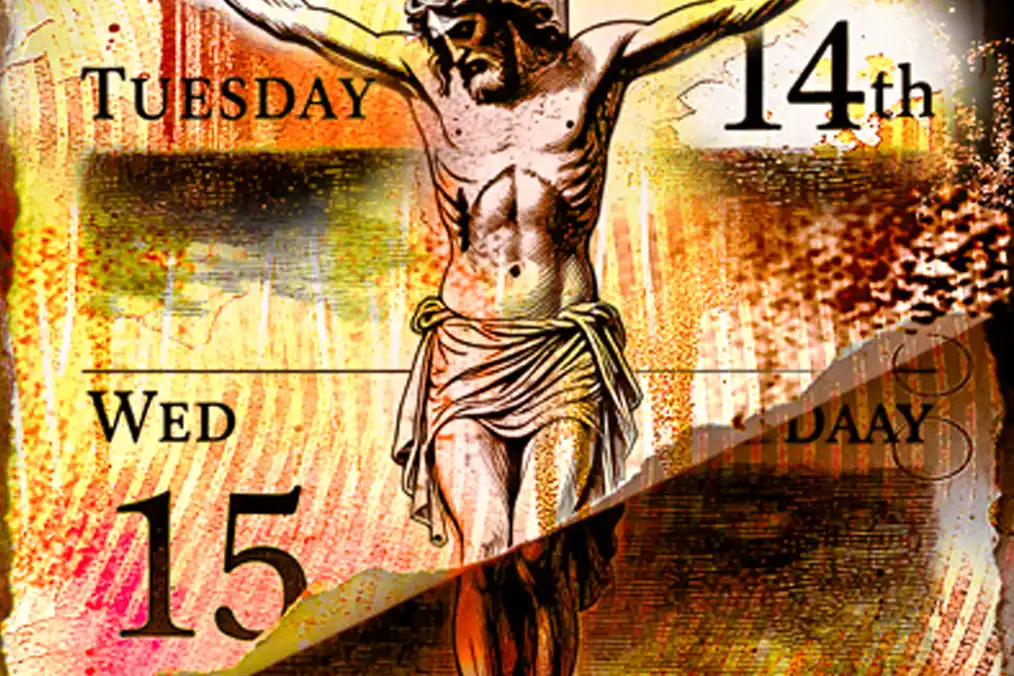
Establishing the Historical and Halakhic Case for a Wednesday Crucifixion and the 72-Hour Period.
The timing of Yeshua's death and resurrection stands as one of the most debated issues in biblical scholarship. Yet when examined through the lens of Second Temple Jewish calendrical practice, halakhic law, and careful Gospel harmonization, a coherent and historically defensible chronology emerges:
Yeshua died on Nisan 14 (the preparation day before Passover proper) between 3 and 5 PM, was buried before sunset, remained in the ground for at least 72 hours—three full days and three full nights—and could lawfully depart/travel from Sheol only after the Sabbath ended on Saturday night.
This timeline not only satisfies the Gospel accounts but also demonstrates Yeshua's perfect compliance with Jewish law and validates the significance of the three days formula in establishing His genuine death.
I. The Crucifixion: Timing Between 3 PM and Sunset
All four Gospels preserve a precise chronology of the crucifixion. Matthew, Mark, and Luke record that darkness covered the land from the sixth hour (noon) until the ninth hour (3 PM), and Jesus died shortly thereafter [Matthew 27:45–50; Mark 15:33–37; Luke 23:44–46]. The sequence is unambiguous: after three hours of darkness, the crucifixion was completed.
This timing allowed for immediate burial before sunset. Jewish law strictly prohibited leaving bodies exposed on the stake overnight, as [Deuteronomy 21:22–23] mandates: you shall bury him that day; for he who is hanged is accursed of God. You shall not defile your land. The Gospels confirm this law was observed: Joseph of Arimathea obtained Pilate's permission, rushed to Golgotha, and completed the burial before nightfall [Matthew 27:57–60; Mark 15:42–46; Luke 23:50–54].
The question of how quickly could a man die on a cross? has ancient documentation. The Gospel of John records that Jesus did not have His legs broken, unlike the two thieves crucified with Him [John 19:31–33]. This detail confirms He had already died. Crucified men typically remained on the cross for hours or even days; the Gospel accounts indicate Jesus' death came swiftly, suggesting the extreme trauma and blood loss from His prior beating and scourging [Matthew 27:26; Mark 15:15]. Thus, death sometime between 3 PM and 5 PM is historically and medically consistent with the Gospel record.
Some interpreters raise the question of John's sixth hour (Roman noon) at John 19:14 for the trial. Yet this timeline is entirely compatible with death several hours later. Pilate's judicial proceedings would have taken time; carrying the cross to Golgotha (uphill, outside the city) was not instantaneous. The distance from the Praetorium to Golgotha was roughly 600 meters—a journey of perhaps 30–45 minutes with a cross-bearer. Crucifixion itself would commence by early afternoon, leaving ample time for Jesus to expire between the ninth and eleventh hours (3–5 PM).
II. Nisan 14 as the Preparation Day: The Essene and Pharisaic Calendars
The Gospels consistently place the crucifixion on the preparation day (paraskeue in Greek), the day before Passover proper. This timing is not incidental — it resolves what would otherwise be a serious halakhic problem, since no executions could occur on Yom Tov (days of solemn assembly). If the crucifixion took place on the preparation day, Nisan 13, it fell before the onset of Nisan 14 at sunset, and was therefore legally permissible under Jerusalem's Pharisaic observance.
The calendrical picture becomes clearer when we account for the dual liturgical calendars operating in Second Temple Judaism. The Essene solar calendar, preserved in the Dead Sea Scrolls, fixed Passover to a Wednesday each year, independent of the lunar reckoning used by the Jerusalem Temple priesthood. This means that Essene and Pharisaic observances of Nisan 14 could fall on different days in any given year. If the Essenes observed Passover beginning Tuesday at sunset (Nisan 14 by their reckoning), and the Jerusalem establishment observed it beginning Wednesday at sunset (Nisan 14 by theirs), then Wednesday daytime — still Nisan 13 by Pharisaic counting — was the preparation day in Jerusalem. The crucifixion falls squarely within this window.
John's Gospel specifies that Jesus was crucified on the preparation day of the Passover (John 19:14), and the timing is precise: the Passover lambs were slaughtered in the Temple between the ninth and eleventh hours (approximately 3:00–5:00 PM), the same window in which Jesus died on the cross. The Synoptics, for their part, record that the meal Jesus shared with His disciples the previous afternoon was not the Passover itself — which was never consumed — but the Covenant meal (the Seudah Maphsehket, discussed below), eaten in anticipation of a Passover that the crucifixion would precede. The accounts are not in tension; they describe successive events within the same preparation-day sequence, with John emphasizing the Temple ritual and the Synoptics preserving the prior afternoon's covenant meal.
III. The Last Supper: A Seudah Maphsehket, Not a Passover Seder
A critical detail for establishing the correct timeline is understanding what meal Yeshua shared with His disciples. The Seudah Maphsehket (the last supper in Hebrew) was a traditional Galilean meal observed on the afternoon before Passover. This is documented in Mishnah Pesachim 10:1, which notes regional differences in Passover observance. According to the tradition, Galilean males would gather for this meal on the evening of Nisan 13, marking the beginning of Nisan 14 (since Jewish days commence at sunset).
Following this meal, firstborn males would begin the Fast of the Firstborn (Taanit Bechorot), commemorating the sparing of Israel's firstborn during the Egyptian plague. This fast continued until the actual Passover seder, which was consumed the following evening. Yeshua, as the firstborn Son destined for sacrifice, participated in this fast. This was not the Pharisaic Passover seder, on the evening before His crucifixion.
The Gospel evidence supports this. Both Matthew and Mark describe Jesus stating that the Passover is two days away, spoken at the Last Supper [Matthew 26:2; Mark 14:1]. This phrasing presupposes He is not eating the Passover at that moment. Furthermore, the Gospel of John uses language denoting a covenant meal distinct from Passover, and later Eucharistic theology beginning with [1 Corinthians 11:23–26] treats the Last Supper as a new covenant meal, not a seder.
Early Church tradition confirmed this understanding. Melito of Sardis, writing in 170 AD, composed a liturgical work titled Peri Pascha (On Passover), which was recited on the 14th of Nisan. This demonstrates that early Jewish believers in Yeshua observed the crucifixion date as the redemptive Passover. The Talmud itself preserves a reference to the crucifixion on Nisan 14, stating on the eve of the Passover Yeshu the Nasarean was hanged [Sanhedrin 43a]. The term hanged is the rabbinic designation for crucifixion.
IV. Three Days and Three Nights: The 72-Hour Requirement
[Matthew 12:40] presents Jesus saying, For just as Jonah was three days and three nights in the belly of the great fish, so will the Son of Man be three days and three nights in the heart of the earth. This is not merely symbolic language; it reflects a halakhic principle rooted in Jewish understanding of death and the departure of the spirit from the body.
The rabbinic tradition in Leviticus Rabbah 18:1 and the tractate Semahot [Tractate Evel Rabbati] preserve the principle that the spirit does not depart from the body until the third day has fully passed. According to this tradition, only after three full days (72 hours) can the deceased be considered irreversibly dead; the possibility of healing or resuscitation is exhausted. This understanding lies behind the raising of Lazarus, whom Jesus called forth after four days [John 11:39], explicitly to prove that Lazarus was authentically dead, not merely unconscious.
The timeline fulfilling the 72-hour requirement runs as follows:
- Wednesday (Nisan 14) afternoon: Burial before sunset = Start of count
- Wednesday (Nisan 14) sunset onwards: Night 1
- Thursday (Nisan 15, Passover) daytime: Day 1
- Thursday sunset onwards: Night 2
- Friday (Nisan 16, Intermediate Passover/Chol HaMoed) daytime: Day 2
- Friday sunset onwards: Night 3
- Saturday (Nisan 17, Sabbath) daytime: Day 3
By the time Saturday sunset arrives, 72 hours have elapsed. Hebrew inclusive counting—which permits reckoning parts of days as full days when they begin and end calendar units—supports this calculation. Thus, three days and three nights is not merely poetic; it is precisely fulfilled by the burial-to-Sabbath-end interval.
The critical point is that this 72-hour period proves Yeshua was genuinely dead. The rabbinic principle ensured He was not merely unconscious or in a coma. Only after three full days did the halakha recognize death as complete and irreversible. Yeshua's adherence to this 72-hour threshold—rather than, say, rising after 36 hours—demonstrates His submission to Jewish law and the authenticity of His death. This addresses the ancient objection, sometimes called the swoon theory, that Jesus merely fainted or revived from unconsciousness. The Gospels and the early kerygma (preaching) insisted He had truly died and been in the realm of the dead (Sheol/Hades) for a measurable, verifiable period.




V. Why the Women Could Not Anoint the Body: Halakhic Restrictions on Chol HaMoed and Sabbath
All four Gospels record that women came to the tomb to anoint or prepare the body with spices and perfumes, yet they arrived on Sunday morning, not before [Matthew 28:1; Mark 16:1–2; Luke 24:1]. Modern interpreters often treat this as merely circumstantial, perhaps the women were simply grieving and lost track of time. Yet the Gospel narratives, combined with Jewish law, suggest a more deliberate restriction.
The halakhic framework is precise. On Friday evening and all day Saturday (the Sabbath, Nisan 17), melacha (creative labor) was strictly prohibited. This included all manner of work, preparation, and tending to needs that were not strictly urgent. Beyond Sabbath law, Friday was Chol HaMoed (the intermediate days of Passover, Nisan 16), when certain restrictions also applied.
Regarding post-burial care specifically, the Mishnah contains crucial guidance. [Mishnah Moed Katan 1:6] permits only those actions needed to complete burial—washing, grooming, and shrouding—during the festival week. It explicitly restricts additional tomb work, tomb-making, and other non-urgent activities. This distinction between what was immediately necessary for burial and what could be deferred is fundamental to festival law.
Since Yeshua's body had already been buried and anointed by Joseph of Arimathea and Nicodemus on Wednesday evening [John 19:39–42], the women's anointing constituted a secondary act of honor, not an urgent burial necessity. According to halakha, such secondary and creative tending would violate the restrictions of both Chol HaMoed and Sabbath. The Talmud in [Moed Katan 8a] discusses the collection of bones and secondary handling of remains and questions whether such actions are fitting during the festival at all. The principle preserved in later codification [Shulchan Arukh, Orach Chayim 547:10] clearly distinguishes between urgent burial tasks and later acts of enhancement. Once the deceased was already in the tomb, spice-mixing, oil preparation, anointing, or other creative acts of honor would normally be viewed as deferrable rather than urgent, and therefore contrary to the restrictions of Chol HaMoed until the sacred period was over.
Furthermore, the women may not have known about the seal on the tomb, a detail preserved in [Matthew 27:66], and they were fearful and in hiding, aware of their status as followers of an executed criminal whom they had seen condemned by the religious authorities. The Gospels suggest their anxiety and caution [John 20:19]. Thus, between halakhic restriction and their own circumspection, they waited until all festival and Sabbath restrictions had lifted—which occurred at sunset on Saturday (the end of Nisan 17). Only then, in the early morning of Sunday, was anointing both permitted and safely possible.
VI. Theological Significance: Death, Compliance with Law, and Resurrection
The precision of this chronology carries profound theological weight. First, the 72-hour period establishes Yeshua's genuine and complete death. It is not a resurrection within hours of burial (which could invite skepticism about unconsciousness or resuscitation) but a death that satisfied the fullest halakhic definition of death as irreversible. The early kerygma emphasized this: [1 Corinthians 15:3–4] preaches that Yeshua died for our sins according to the Scriptures, and was buried, and was raised on the third day according to the Scriptures. The phrase raised on the third day is not arbitrary—it echoes both Jonah's typology and the Jewish legal principle that death is complete and irreversible only after three days have passed.
Second, the Wednesday crucifixion and the explicit observance of festival restrictions demonstrate Yeshua's perfect compliance with Torah. He did not violate Sabbath law, nor did He permit His body to remain on the stake beyond nightfall. He submitted to the halakhic categories and calendar of His people. This compliance is essential to His claim as the faithful Israelite—and ultimately as the promised seed of David, who was to be righteous and upright [Psalm 89:4].
Third, the chronology validates the signs and wonders traditions embedded in the Gospels. The women's inability to anoint Him before Sunday is not an inconsistency or plot hole; it is a halakhic necessity, a window into how the early disciples understood Jesus' death through the lens of Jewish law. The narrative coherence—death, burial, sealed tomb, festival restrictions, women waiting until Sunday morning—demonstrates sophisticated knowledge of Second Temple practice and legal reasoning.
Finally, this chronology addresses the typological dimensions of Jesus' passion. Jonah in the fish for three days and three nights [Jonah 1:17]; the righteous remnant spared in the plague of darkness [Exodus 10:22–23]; the Passover lamb slaughtered and the firstborn redeemed [Exodus 12–13]—all converge in the death of Yeshua on Nisan 14, at the very moment the Passover lamb is being ritually slaughtered in the Temple. His death fulfills, recapitulates, and supersedes the typology of redemption that runs through Israel's foundational story.
Conclusion: A Coherent and Defensible Chronology
When examined through the lens of Second Temple Jewish calendrics, halakhic practice, and careful exegesis, the Gospel accounts reveal a precise and historically coherent chronology. Yeshua died on Nisan 13 (the preparation day), between 3 PM and sunset, was buried before nightfall, and remained in the tomb for exactly 72 hours—three full days and three full nights—before the Sabbath ended on Saturday evening. The women could not anoint His body until First Fruits (Reishit Katzirchem) Sunday morning, not because of narrative carelessness, but because festival law and Sabbath restrictions made earlier anointing impossible and First Fruits (Reishit Katzirchem) has no such restrictions on work. During the festival week and the Sabbath, all creative acts of tending were prohibited; the urgent work of burial had been completed by Joseph and Nicodemus on Wednesday evening, leaving only deferred and non-essential secondary anointing for the women.
This chronology demonstrates that Yeshua's death satisfied the fullest definition of death in Jewish law, lasted the precise period required by halakhic tradition to constitute irreversible death, and occurred in perfect compliance with the Sabbath and festival observances. It also resolves the apparent tensions between the Synoptic and Johannine accounts by recognizing the coexistence of Essene and Pharisaic calendars in Second Temple Judaism. Far from being legendary invention or narrative confusion, the Gospels preserve authentic, legally sophisticated memory of how Jesus' death, burial, and the anticipation of His resurrection fit within the calendar and law of His people.
The precision of this timeline—burial at Wednesday sunset, emergence from Sheol at Saturday sunset, discovery of the empty tomb on First Fruits Sunday morning—is not coincidental poetry. It is historical recollection married to theological interpretation. It witnesses to a death that was real, complete, and verifiable according to the standards of the people and the time. And in so doing, it validates the earliest Christian proclamation: that Yeshua was crucified, buried, remained dead for three full days, and was raised on the third day according to the Scriptures [1 Corinthians 15:3–4].
-The Tutor

Read "Seudah Maphsehket"
To learn more about why Jesus had a Last Supper & an afflicted fast.
Read "Reasons the Last Supper is not a Passover Meal"
Why the Last Supper was not a Passover Seder.