
Ark of the Covenant
What is the Ark of the Covenant
The Ark of the Covenant is first introduced in the Old Testament, Exodus 25:10-22, where God gives Moses detailed instructions on how to construct the Ark, which was to be made of acacia wood, overlaid with gold, and contained the stone tablets of the Ten Commandments, Aaron's rod, and a pot of Manna. It was considered the most sacred object in Israelite worship, representing God's presence and covenant with His people. The Ark was also associated with miraculous events, such as the parting of the Jordan River (Joshua 3:14-17) and the fall of the walls of Jericho (Joshua 6:4-20). It resided in the Holy of Holies within the mobile Tabernacle and later the 1st Temple in Jerusalem, signifying the central place of God's dwelling among His people.
What is the Mercy Seat
The lid of the ark is the mercy seat (Kapporet) which in Hebrew means to cover, to purge, to make atonement. This is both the throne of God where he would sit and appear to man as a cloud as well as the spot where atonement would be symbolically made.
“
There I will meet with you; and from above the atoning cover, from between the two cherubim which are upon the ark of the testimony, I will speak to you about every commandment that I will give you for the sons of Israel.
Exodus 25:22
”
On Yom Kippur, the Day of Atonement, the High Priest would enter the Holy of Holies—the innermost and most sacred area of the Tabernacle (and later the Temple)—and sprinkle the blood of a sacrificial animal on the Mercy Seat. This act symbolized the atonement of the people's sins and sought God's mercy.
Miracles of the Ark
In the rabbinical Yoma there are mentioning's of miracles related to the activities of the Ark. One of which in Yoma 54a-b is that the cherubim miraculously changed their positions to reflect the spiritual state of the Israelites. It also covers when Israel did not follow God's commandments, the cherubim faced away from each other, indicating a strained relationship.
“
Rav Katina said: Whenever Israel would ascend to the Temple for the Festival pilgrimage, the curtain [parochet] would be removed for them, and the cherubim were shown to them, whose bodies were intertwined with one another. They would be thus addressed: 'Look! You are beloved before God as the love between a man and a woman.
Yoma 54a
”
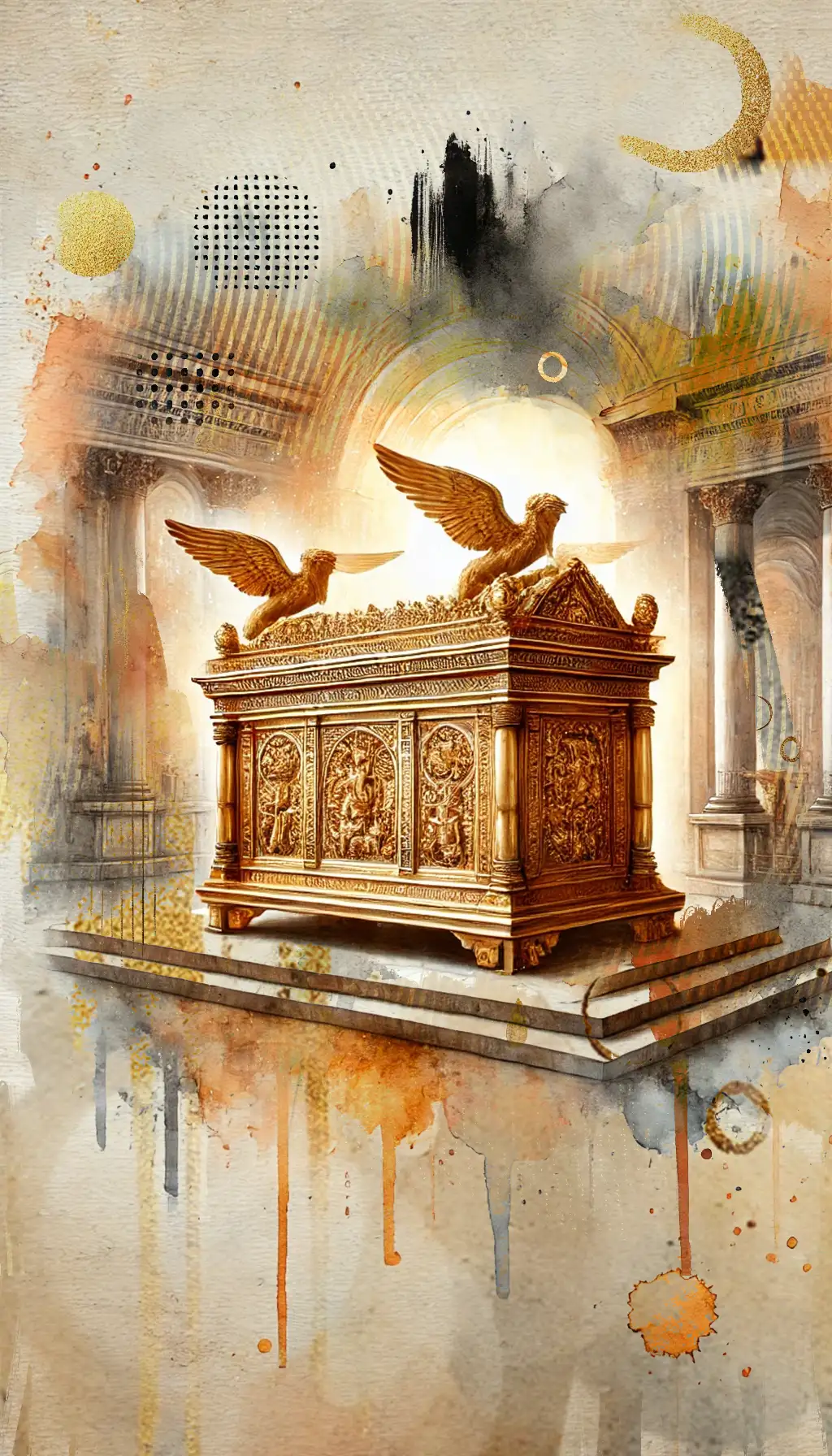
Table of Contents
At the time of the destruction of the First Temple by the Babylonians, it is reported that the cherubim were found embracing each other. This was paradoxical because one might expect them to be turned away due to Israel's sins leading to the Temple's destruction and the Babylonains felt the embrace was inappropriate.
“
When the enemies entered the Sanctuary, they saw the cherubim embracing each other. They took them out to the marketplace and said: 'Look at what the Israelites are occupied with!' They degraded them, for their intimate embrace seemed inappropriate to the outsiders.
Yoma 54b
”
The Ark according to the Jewish records also had a weird spatial relationship to the Holy of Holies. The Ark of the Covenant, along with the cherubim, did not occupy physical space within the Holy of Holies. Despite having measurable dimensions, there was a miraculous spatial phenomenon where the Ark seemed to take up no space at all and the Holy of Holies was larger than it could be by the exact size of the Ark.
“
The Ark was placed in the Holy of Holies, and yet, the space from each side of the Ark to the wall was ten cubits, even though the entire width was twenty cubits. This teaches that the Ark was not part of the measurable space.
Yoma 21a
”
Prophecy About the Ark
The Ark is mentioned in Jeremiah 3:16, where the prophet foretells a time when it will no longer be a focal point of worship or remembered by the people of Israel.
“
And when you have multiplied and been fruitful in the land, in those days, declares JEHOVAH, they shall no more say, “The ark of the covenant of JEHOVAH.” It shall not come to mind or be remembered or missed; it shall not be made again.
Jeremiah 3:16
”
This implies a future where God's presence is not focused on a physical object but is instead experienced more directly and universally. This was achieved with the holy spirit indwelling in his people creating a segment of the temple in them and having them be part of the total body of Messiah.
This prophecy is significant in both Jewish and Christian eschatology, suggesting a new covenant or a messianic age where the Ark's symbolic role is transcended. In the New Testament, the Ark is alluded to in the Book of Revelation 11:19, where the "temple of God" (most likely the believers in Messiah) is opened in heaven, and the Ark of His covenant is seen within, symbolizing the ultimate fulfillment of God's promises and the unification of heavenly and earthly realities.
Fate of the Ark
The fate of the Ark of the Covenant is a subject of much speculation and way too much legend, even though its final whereabouts are documented in the canonical texts. The last tanakh mention is during King Josiah's reign (2 Chronicles 35:3), after which it seemingly disappears from the historical record. Several theories exist about its fate:
2 Maccabees 2:4-8, suggests that the prophet Jeremiah hid the Ark in a cave on Mount Nebo to protect it from the Babylonian invasion.
“
It was also in the same document that the prophet, having received an oracle, ordered that the tent and the ark should follow with him, and that he went out to the mountain where Moses had gone up and had seen the inheritance of God. Jeremiah came and found a cave-dwelling, and he brought there the tent and the ark and the altar of incense; then he sealed up the entrance. Some of those who followed him came up intending to mark the way, but could not find it. When Jeremiah learned of it, he rebuked them and declared: “The place shall remain unknown until God gathers his people together again and shows his mercy.
2 Maccabees 2:4-7
”
Rabbinic writings, such as in the Talmud (Yoma 53b), discuss the argument that the Ark was hidden beneath the Temple Mount before the Babylonians destroyed the First Temple possibly but the majority held that it was taken by the Babylonians as "nothing [davar] shall be left, says the LORD".
“
Behold, the days come, that all that is in thine house, and that which thy fathers have laid up in store until this day, shall be carried to Babylon: nothing shall be left, saith the Lord.
Isaiah 39:6
”
The Dead Sea Scrolls do not provide direct information about the Ark's fate, but some scholars speculate that references to hidden treasures in texts like the Copper Scroll could allude to its concealment. Various traditions and theories have emerged over time, including claims that the Ark was taken to places like Ethiopia or hidden in secret chambers under the Temple Mount, but none of these have been substantiated. Thus, the Ark's current location remains a mystery.
Our Theory
Based on our readings the theory we hold until more evidence is shown is that the Ark of the Covenant has been raptured up to heaven [Revelation 11:19] as the role of the mercy seat as a shadow of atonement was completed, and the focus moved on to the "Lord you are seeking" [Malachi 3:1] who will atone for sins. Also the sanctity of the 2nd Temple was always complicated and constantly in flux, there is a good chance that the presence of God (Shekinah) only tangentially occupied it after he moved to the Mount of Olives (Ezekiel 11:23) or never fully returned. Traditional Jewish teachings often emphasize the absence of the Divine Presence in the Second Temple, highlighting a spiritual loss despite the physical rebuilding. The miracles and visions of the high priests were erratic or complicated in those days and after 32 AD when the veil before the Holy of Holies (the Parochet) was torn in two the miracles ended all together with the priests wondering if they made God mad.
“
...during the forty years prior to the destruction of the Second Temple (70 AD), the lot for God did not arise in the High Priest’s right hand at all. So too, the strip of crimson wool that was tied to the head of the goat that was sent to Azazel did not turn white, and the westernmost lamp of the candelabrum did not burn continually. And the doors of the Sanctuary opened by themselves as a sign that they would soon be opened by enemies...
Yoma 39b
”