
The Gate
“
Hate evil and love good, and establish judgment in the gate.
-Amos 5:15
”
The Gate: Court, Market, Marriage-Seat, and the Guarded Threshold of the Ancient Town
In the towns of ancient Israel the gate was not merely a way in and out. It was the one fixed point where the life of a walled settlement was transacted in public: where judges sat, sales were witnessed, marriages were sealed, kings and prophets addressed the people, grain was priced, and where, at dusk, the doors were barred against raiders and the predators of the open country. The Hebrew word is שַׁעַר (sha’ar), plural שְׁעָרִים (she’arim); in legal language “in your gates” (בִשְׁעָרֶיך, bi-she’areikha) is shorthand for the jurisdiction of a town.
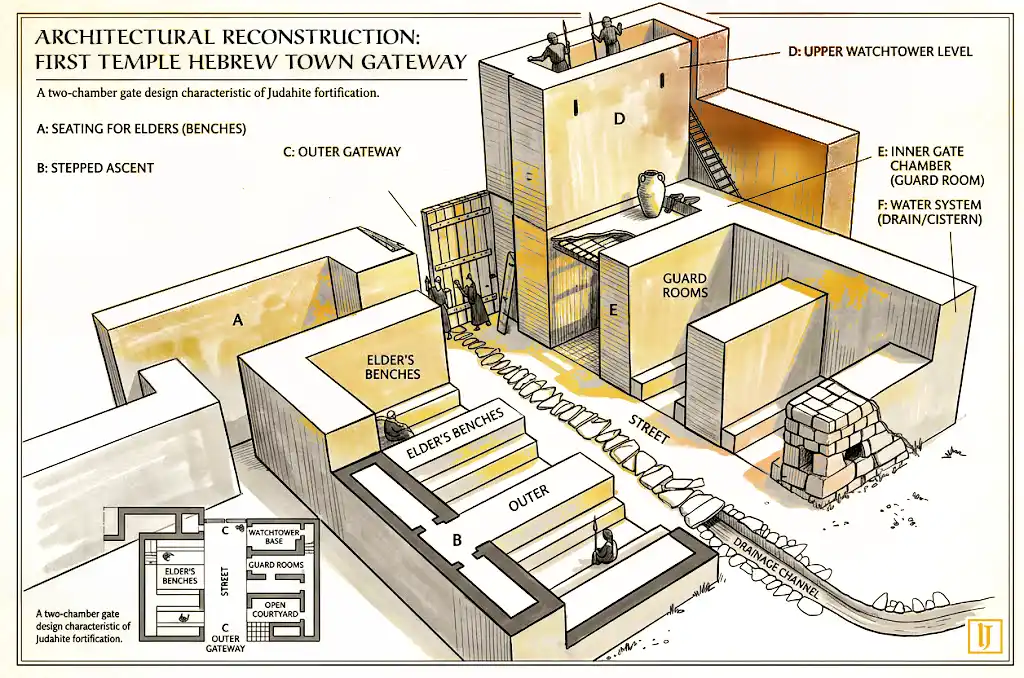
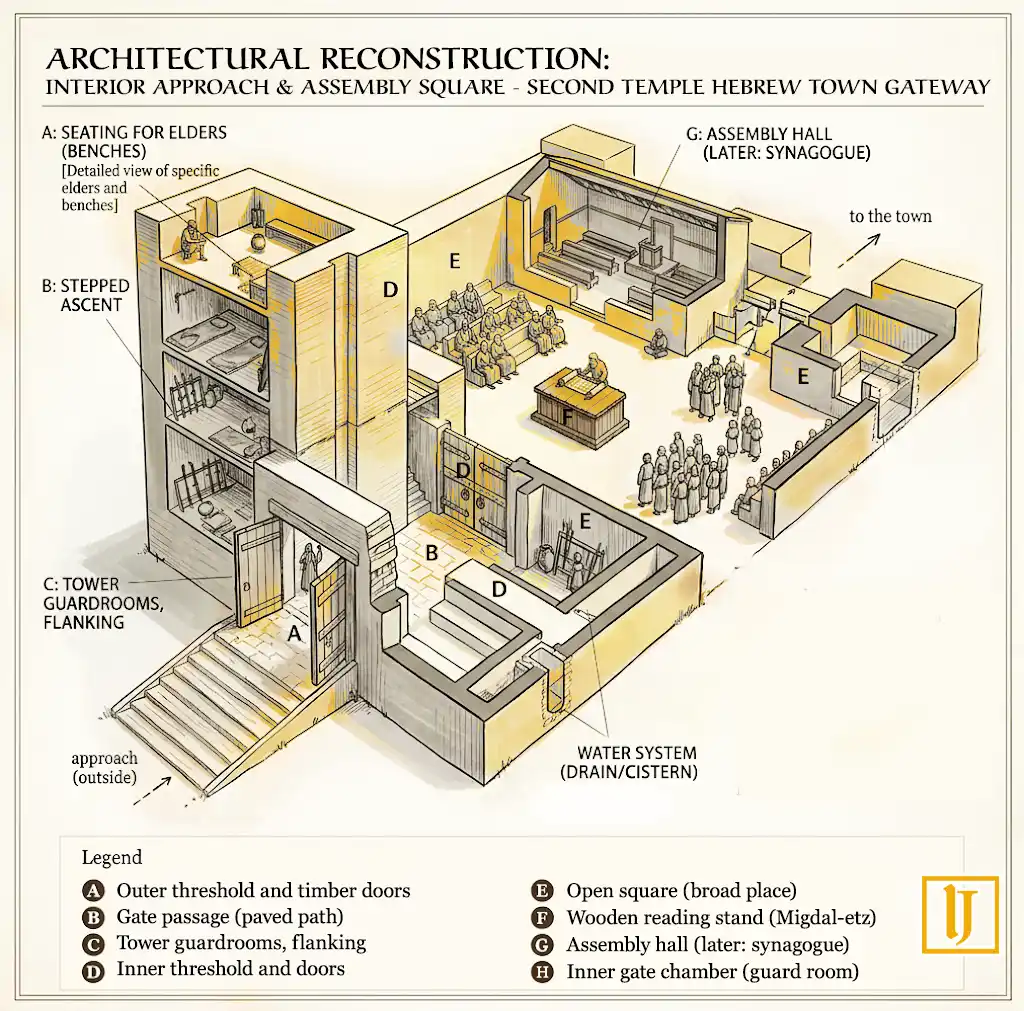
Archaeology and text agree on the form. A typical fortified gate had paired piers framing several flanking chamber cells beside the entrance path, with a paved open space (the רְחוֹב (reḥov), the “broad place”) just inside. Benches lined the recesses. The chambers gave shade and shelter; the plaza gave room for a crowd to gather without obstructing traffic.
It is this paved, sheltered, public-yet-bounded space, not the doorway threshold alone, that the texts have in view when they say a man “sat in the gate.”
- Lot is found sitting in the gate of Sodom [Genesis 19:1]
- Job recalls going out to the gate and preparing his seat in the open square [Job 29:7]
The threshold itself was marked as sanctified ground: the command to inscribe the words of the covenant on the doorposts and on the gates [Deuteronomy 6:9, Deuteronomy 11:20] placed the household and the town under written obligation at the point of entry but the gate of people was the public space farther inside.
JUDGEMENT
The Seat of the Court
The gate’s primary civic role was judicial. The law of the courts is given in the language of the gate:
“Judges and officers you shall appoint for yourself in all your gates”
-Deuteronomy 16:18
Cases beyond a local court’s competence were referred upward to the central tribunal at the chosen place [Deuteronomy 17:8–9]. King Jehoshaphat’s reform is described as the appointment of judges city by city, an extension of the same gate-court system [II Chronicles 19:5–8].
Table of Contents
The gate was where a case was heard and also where sentence fell: the condemned idolater and others found guilty were taken out “to the gates” to be stoned [Deuteronomy 17:5, Deuteronomy 22:24]. It was also where a defendant first stated his cause: the manslayer fleeing to a city of refuge stood at the entrance of the city gate and pleaded his case in the hearing of the elders [Joshua 20:4].
The prophets treat the gate as the test of a society’s justice. Amos condemns those who hate honesty, justice and fairness to the poor there, and calls for judgment to be established in the gate [Amos 5:10, Amos 5:12, Amos 5:15]. Isaiah names those who lay a snare for the arbiter in the gate [Isaiah 29:21]. Zechariah’s charge is to judge truth and peace in the gates [Zechariah 8:16]. Proverbs warns against crushing the afflicted in the gate [Proverbs 22:22]. When the institution fails, the loss is registered in the same idiom: “the elders have ceased from the gate” [Lamentations 5:14].
Continuity into the Second Temple period
As formal courts developed, the gate remained their physical and conceptual home. The Mishnah preserves a tiered structure: courts of three for minor matters, of twenty-three for capital cases, and the supreme court of seventy-one [Mishnah Sanhedrin 1:1–6]. Its account of the rebellious elder traces an appeal through three seats, two of them gates: the court at the entrance to the Temple Mount, the court at the entrance to the Temple court, and the Chamber of Hewn Stone [Mishnah Sanhedrin 11:2]. The Babylonian Talmud transmits the same arrangement in the name of Rabbi Yose: a court of seventy-one in the Chamber of Hewn Stone, courts of twenty-three at the gate of the Temple Mount and the gate of the courtyard, and courts of twenty-three in the towns [Sanhedrin 88b]. The Tosefta’s tractate Sanhedrin preserves parallel traditions on the gradation of these courts and the passage of cases between them [Tosefta Sanhedrin].
Josephus, writing before 100 AD, restates the Mosaic constitution in the same terms:
Let there be seven men to judge in every city, and these such as have been before most zealous in the exercise of virtue and righteousness. Let every judge have two officers allotted him out of the tribe of Levi.
The Aramaic Targum to Ruth, rendering the gate scene of [Ruth 4], glosses “the gate” outright as “the court of the (Beth Din בֵּית דִּין) Sanhedrin”; a direct witness to how the gate was read by later tradition [Aramaic Targum to Ruth 4].
CONTRACT
Sale, Deed, and the Witnessing Assembly
Because the gate held the crowd, it held the witnesses; and witnesses made a transaction binding. The model conveyance in the Tanakh is Abraham’s purchase of the cave of Machpelah. The negotiation is concluded:
“in the hearing of the sons of Heth (Canaan), To all who enter the city gate, to say... to Abraham as a possession in the presence of the sons of Heth, before all who entered the gate of his city.”
-Genesis 23:10, Genesis 23:18
The gathered public is the registry: their presence is the record.
The redemption scene in Ruth is the fullest surviving description of the procedure. Boaz goes up to the gate and sits; he seats the nearer kinsman, then seats ten elders of the town as a quorum; the transfer of the right of redemption is sealed by the drawing-off of the sandal; and the assembly declares,
“We are witnesses”
-Ruth 4:1–12
The Midrash dwells on this declaration, taking the people in the gate and the elders together as the formal body of witnesses to the act [Ruth Rabbah 7:13]. The same Midrash treats the meeting as providentially arranged so that the matter could be settled without delay before the seated court [Ruth Rabbah 7:7]. The sober point beneath the narrative is procedural: a property right changed hands by a witnessed ceremony at the gate, and the change was thereby enforceable.
MARRIAGE & FAMILY LAW
Betrothal, Levirate, and the Discipline of the Household
Marriage law was administered at the gate because marriage created and dissolved rights that the community had to recognize. In the same Ruth proceeding, acquiring the field carried with it the obligation to take Ruth as wife and raise up a name for the deceased; the marriage and the conveyance are a single witnessed act before the elders [Ruth 4:9–11].
Where a brother-in-law refused the levirate duty, the widow brought the matter to the elders in the gate; if he persisted, she performed חֲלִיצָה (halitzah) (loosing his sandal and declaring his refusal) before that court [Deuteronomy 25:7–9]. A dispute over a bride’s virginity was tried before the elders at the gate, where the tokens were produced as evidence [Deuteronomy 22:13–21]. A son charged as incorrigibly rebellious was likewise brought to the elders at the gate of his place [Deuteronomy 21:18–21]. In each case the gate is the venue where family status (married or released, honored or shamed) was fixed in the sight of the town.
ASSEMBLY
The King, the Prophet, and the Reading of the Law
Because everyone passed through it, the gate was the place to be seen and heard. Kings held court there:
- After Absalom’s defeat, David is summoned back to his seat in the gate so the people may pass before him [II Samuel 19:9]
- The kings of Israel and Judah sit enthroned at the entrance of the gate of Samaria [I Kings 22:10]
- Zedekiah takes his place in the gate of Benjamin [Jeremiah 38:7]
- Absalom understood the gate’s leverage exactly, he stood beside the road to the gate, intercepting litigants on their way to be judged, and so “stole the hearts” of Israel [II Samuel 15:2–6]
Communal decisions were taken there as well: Hamor and Shechem bring their proposal before the men of their city at the gate [Genesis 34:20]. In the Persian-period diaspora the same institution reappears as “the king’s gate,” the seat of royal officials where Mordecai sits and conducts the king’s business [Esther 2:19, Esther 2:21, Esther 3:2], and where Daniel is set over the administration of Babylon [Daniel 2:49].
Prophets and teachers used the same platform. Jeremiah is told to stand in the gate and address all who enter [Jeremiah 17:19–20. Wisdom is personified crying out at the openings of the gates and the entrance of the city [Proverbs 1:21. Proverbs 8:3]. A major public reading of the Law takes place not in the Temple but in the open square before the Water Gate, where Ezra reads from morning until midday to the assembled people [Nehemiah 8:1–3]; Hezekiah had earlier gathered the people to the square at the gate to address them [II Chronicles 32:6].
To “sit in the gate” was therefore a mark of standing. The capable wife’s husband is known in the gates, taking his seat among the elders [Proverbs 31:23]. Conversely, Ben Sira’s second-century BC catalogue of trades notes that the craftsman, however necessary, is not sought for the council and does not sit in the judge’s seat or rise to eminence in the assembly (the assembly being precisely the gathering the gate convened [Ben Sira 38:32–33]).
MARKET
Trade, Measure, and Price
The same concentration of people made the gate the marketplace, and so the place where prices and measures were public knowledge. The relief of Samaria’s famine is announced as a market quotation:
a measure of fine flour for a shekel “in the gate of Samaria”
-II Kings 7:1
The gate being where such a price would be quoted and verified. Nehemiah’s Sabbath reform is enforced at the gate: he orders the doors shut as evening fell before the Sabbath and posted his servants so that no burden of merchandise should enter, after merchants and sellers of every kind had taken to lodging outside [Nehemiah 13:15–22]. Several of Jerusalem’s gates take their names from the goods that passed through them (the Fish Gate and the Sheep Gate among them [Nehemiah 3:1]), the trace of markets held at each.
DEFENSE
Bars, Watchmen, and the Shutting at Dusk
The gate was also the weakest point in a wall, and so the most fortified. Fortified cities are summarized as having “high walls, gates, and bars” [Deuteronomy 3:5]. The psalmist credits security to the same hardware: God strengthens the bars of the city’s gates [Psalms 147:13]. Watch was kept from the chamber over the gate (the lookout who first sees the runner approaching, and the room to which David withdrew to mourn [II Samuel 18:24, II Samuel 19:1]). Samson’s feat of carrying off the doors of the gate of Gaza, posts and bar together, is a feat precisely because that assembly was the city’s defense [Judges 16:3].
The decisive defensive act was the daily shutting of the gate. At Jericho the gate was shut at dark, in the time of closing, after the day’s traffic [Joshua 2:5, Joshua 2:7]. Nehemiah tightened the rule for restored Jerusalem, ordering that the gates not be opened until the sun was hot and that they be barred and guarded while the watchmen were still posted [Nehemiah 7:3]. In the Hasmonean period the rebuilt strongholds are described in the same way: Simon fortified the towns with high towers, great walls, gates, and bars [I Maccabees 13:33], and Mount Zion was rebuilt with high walls and strong towers lest the gentiles trample it again [I Maccabees 4:60]. Josephus, describing Jerusalem on the eve of its fall, gives the gates of the city and the Temple in detail as the hinges of the whole defense [War of the Jews V].
The Danger Beyond the Wall: Lions and the Beasts of the Field
What the closed gate held out was not only human raiders. The land was still lion country. When Samaria was depopulated by deportation, the texts report that lions multiplied among the new settlers and killed them [II Kings 17:25–26]; a man who disobeyed a word of the Lord is killed by a lion on the road [I Kings 13:24]; David recounts killing both lion and bear that came against the flock [I Samuel 17:34–35]; a young lion roars against Samson on the way to Timnah [Judges 14:5]; and Jeremiah’s recurring image is of the lion coming up from the dense thickets of the Jordan against the settled fold [Jeremiah 49:19]. Amos draws the contrast that makes the gate’s function vivid: the man who escapes the lion in the open meets the bear, and reaching the safety of the house leans his hand on the wall and is bitten by the serpent [Amos 5:19]. Outside the barred gate at night lay exactly this country. The shutting of the gate at dusk drew the line between the inhabited, defended town and a darkness in which predators ranged.
SANCTUARY
The Gate of the Temple and the Gate of Heaven
Every civic meaning of the gate was carried over to the sanctuary, and from there to the language of access to God. Jacob names the place of his dream “the gate of heaven” [Genesis 28:17]. The processional psalms summon the gates themselves to open for the entrance of the King of glory [Psalms 24:7–9], call the worshipper to enter the gates with thanksgiving [Psalms 100:4], and name “the gates of righteousness” through which the just enter [Psalms 118:19–20]. Ezekiel’s visionary temple reserves the shut eastern gate, through which the prince alone may eat bread before the Lord [Ezekiel 44:1–3], and his restored city has twelve gates named for the tribes [Ezekiel 48:30–34].
The Second Temple imagination extended the pattern. The Temple Scroll from Qumran prescribes a sanctuary whose courts are ringed by twelve gates, each bearing the name of a tribe of Israel; the same scheme as Ezekiel [11Q19, Temple Scroll, cols. 39–41]. When the Maccabees retook the sanctuary they found its gates burned, and the rededication is marked in part by restoring the gates and the chambers and hanging their doors [I Maccabees 4:57].
The Gate in the New Testament and the Early Church
The Gospels and Acts keep the civic gate as a real place. A widow’s only son is carried out at the gate of Nain, where a crowd has gathered [Luke 7:12]; a lame man is laid daily at the Temple gate called Beautiful to ask alms of those entering [Acts 3:2, Acts 3:10]; Paul finds a place of prayer outside the gate by a riverside [Acts 16:13]; and execution “outside the gate” carries its old meaning of exclusion from the community when applied to the crucifixion [Hebrews 13:12].
The gate also becomes a figure for decision and access. The teaching of the narrow gate sets two entrances against each other, one wide and one strait [Matthew 7:13–14]; the “gates of Hades” stand for the powers that will not prevail against or resist the assembly [Matthew 16:18]; and the door becomes a name for the one through whom any enter [John 10:9]. The vision of the new Jerusalem returns to Ezekiel’s plan; twelve gates inscribed with the names of the twelve tribes [Revelation 21:12] and then inverts the defensive function entirely: those gates are never shut, for there is no night there [Revelation 21:25]. The fear that closed the gate at dusk is simply.... gone.
The earliest church writers continued the image. Ignatius of Antioch, before his death about 110 AD, names the High Priest “the door of the Father, by which enter in Abraham, and Isaac, and Jacob, and the prophets, and the apostles, and the Church” [Ignatius, Epistle to the Philadelphians 9]; the gate now read as the single, guarded entrance into the household of God.
Across more than a thousand years of texts the picture holds steady. The gate concentrated the public functions of a settlement at its one controlled opening: it judged, recorded, married, proclaimed, traded, and defended. The legal vocabulary outlived the architecture; the Second Temple courts still convened at the Temple gates, and “the gate” could still be defined as the court itself; and the theological vocabulary outlived the city, until the last vision describes a city whose gates need never close.
“
Yahweh loves the gates of Zion more than all the dwellings of Jacob.
-Psalm 87:2
”
Read "Seat of Moses"
For more information see "Seat of Moses".
Read "Chain of Learning"
For more information see "Chain of Learning".
Read "Cockcrow"
For more information see "Cockcrow".